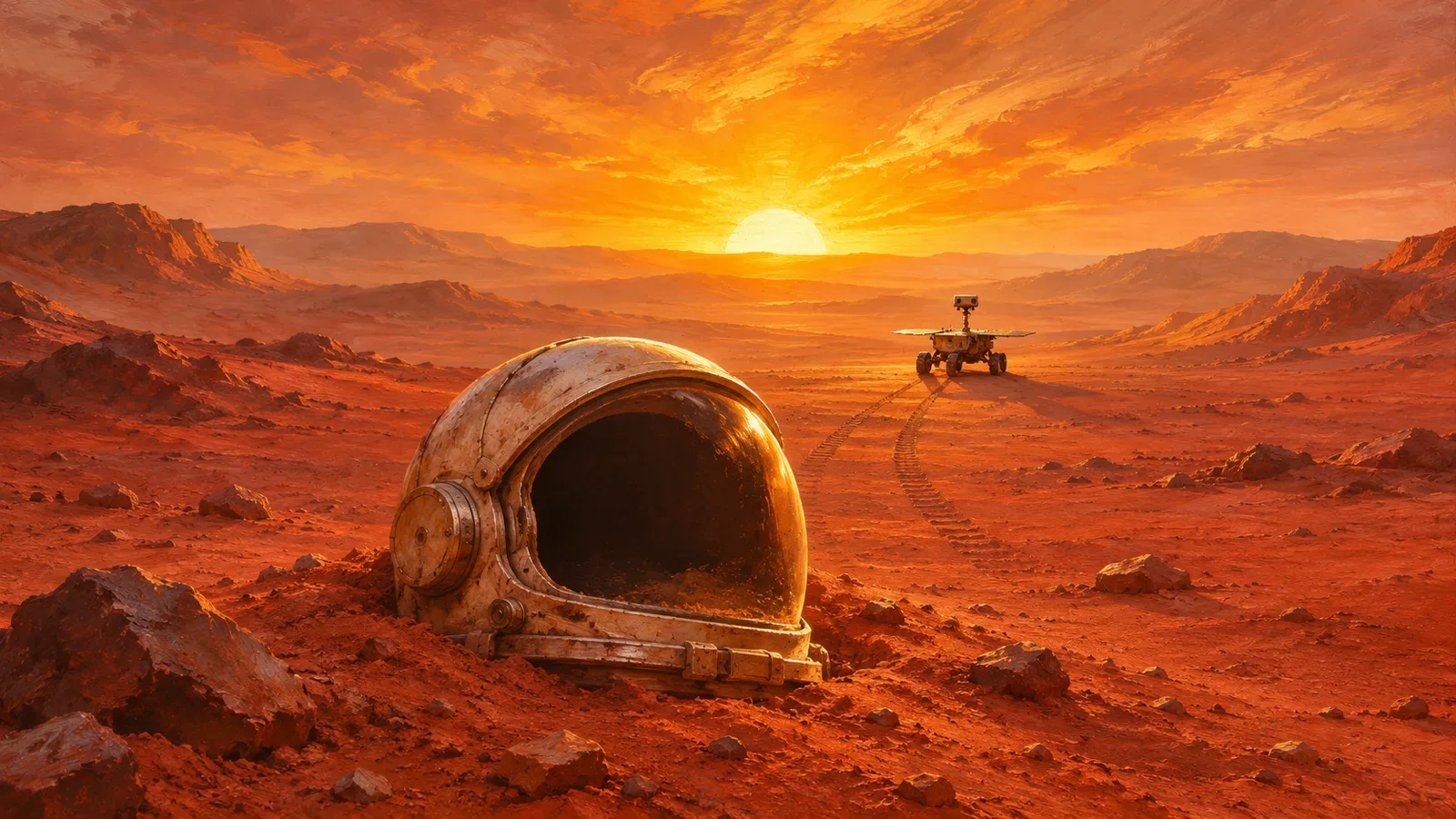
Astronauts are a rounding error. So far this year the world has tried to reach orbit 264 times. Five of those rockets had people on top. Last year, the last full count, it was eight out of 330. Space is busier than it has ever been, and almost none of it involves a human being.
We still talk about spaceflight as if it were a story about brave people in white suits. It stopped being that a long time ago. The machines took the job, they are better at it, and the gap gets wider every year. The age of the astronaut is not coming to an end. It ended, and nobody held the funeral.
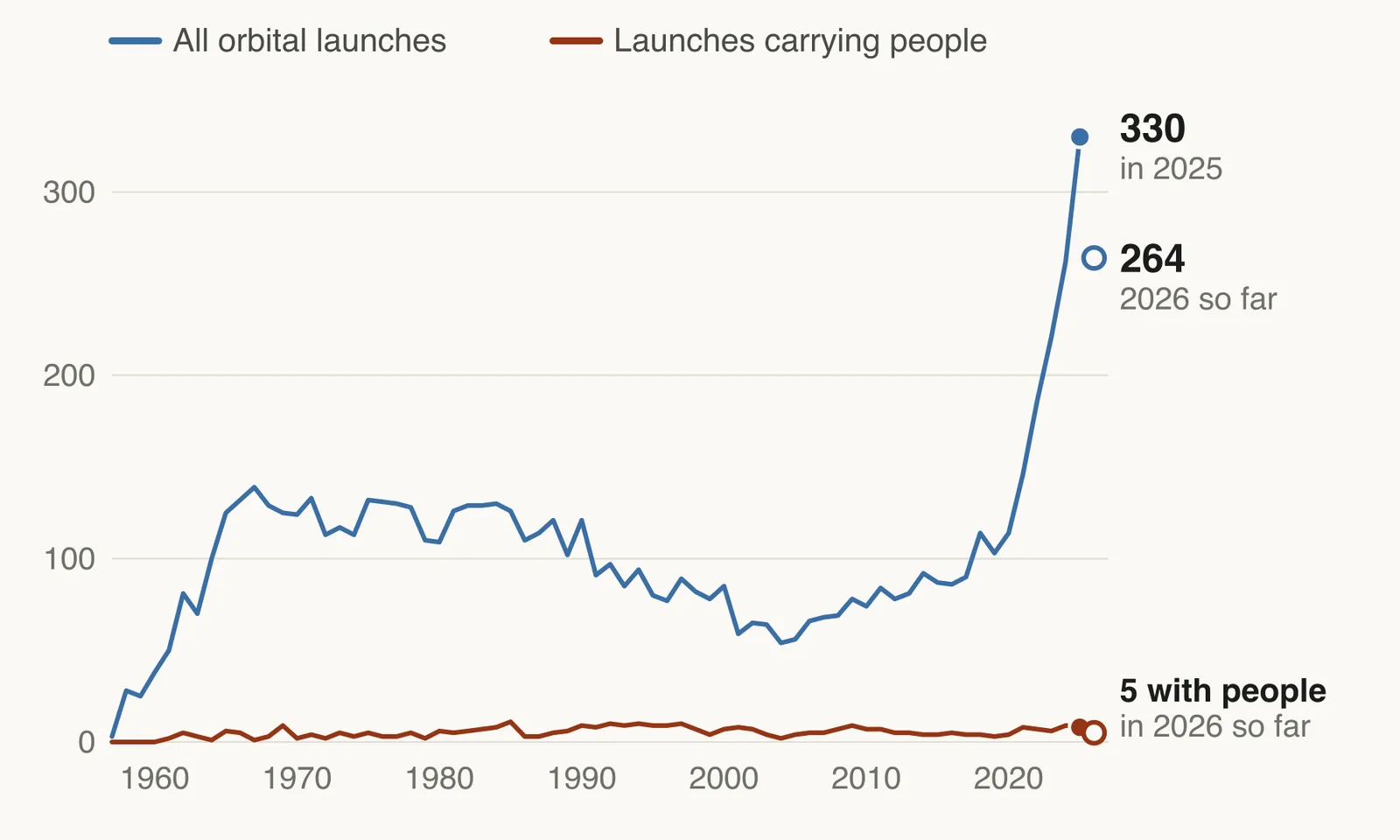
Orbital launch attempts per year worldwide, 1957 to 2026. Hollow dots are 2026 to 8 November. Source: Jonathan McDowell, General Catalog of Artificial Space Objects.
Count the Seats
In short
Launches have nearly quadrupled in ten years. Crewed launches have not moved. The share of rockets with a person aboard fell from 13.6% in 2001 to under 2% today.
Here is the number that should end the argument. In 2001, a little over one launch in eight carried a crew: 13.6%, the highest share on record. Last year it was 2.4%. This year, through early November, it is 1.9%.
That is not mainly because crewed flights dried up. We still fly a handful of them a year, a few fewer than in the 1990s. It is because everything else exploded. Satellites, constellations, probes, telescopes, cargo. The work of space grew by hundreds of launches a year, and none of that growth needed a pilot.
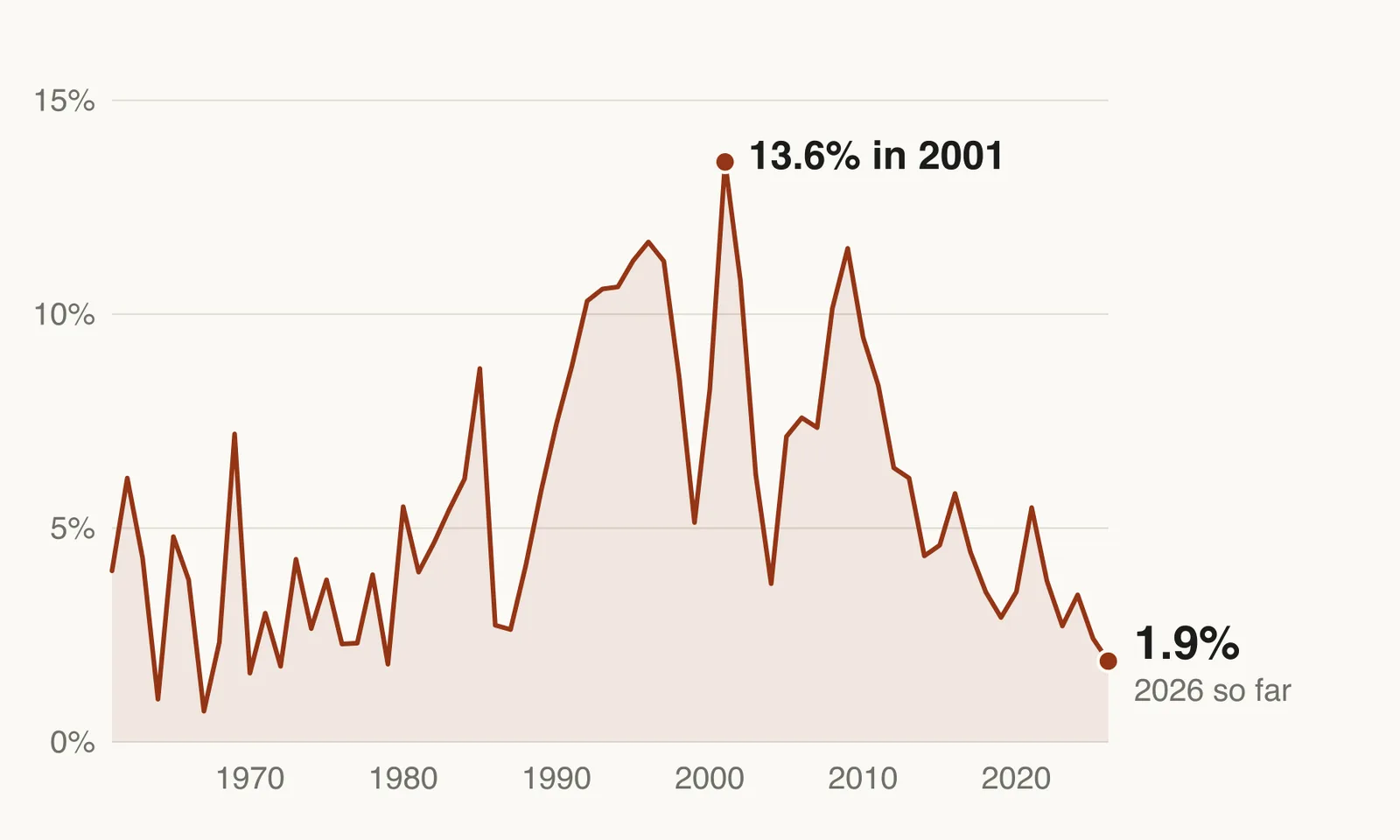
Share of orbital launches with a crew aboard, 1961 to 2026. Source: Jonathan McDowell, GCAT and human spaceflight lists.
Even the people who do fly are changing. NASA's astronaut corps had nearly 150 members in 2000. By January 2022 its own inspector general counted 44. This November the number was 32. Meanwhile a growing slice of the seats to orbit go to paying customers. The job title is quietly turning from explorer into passenger.
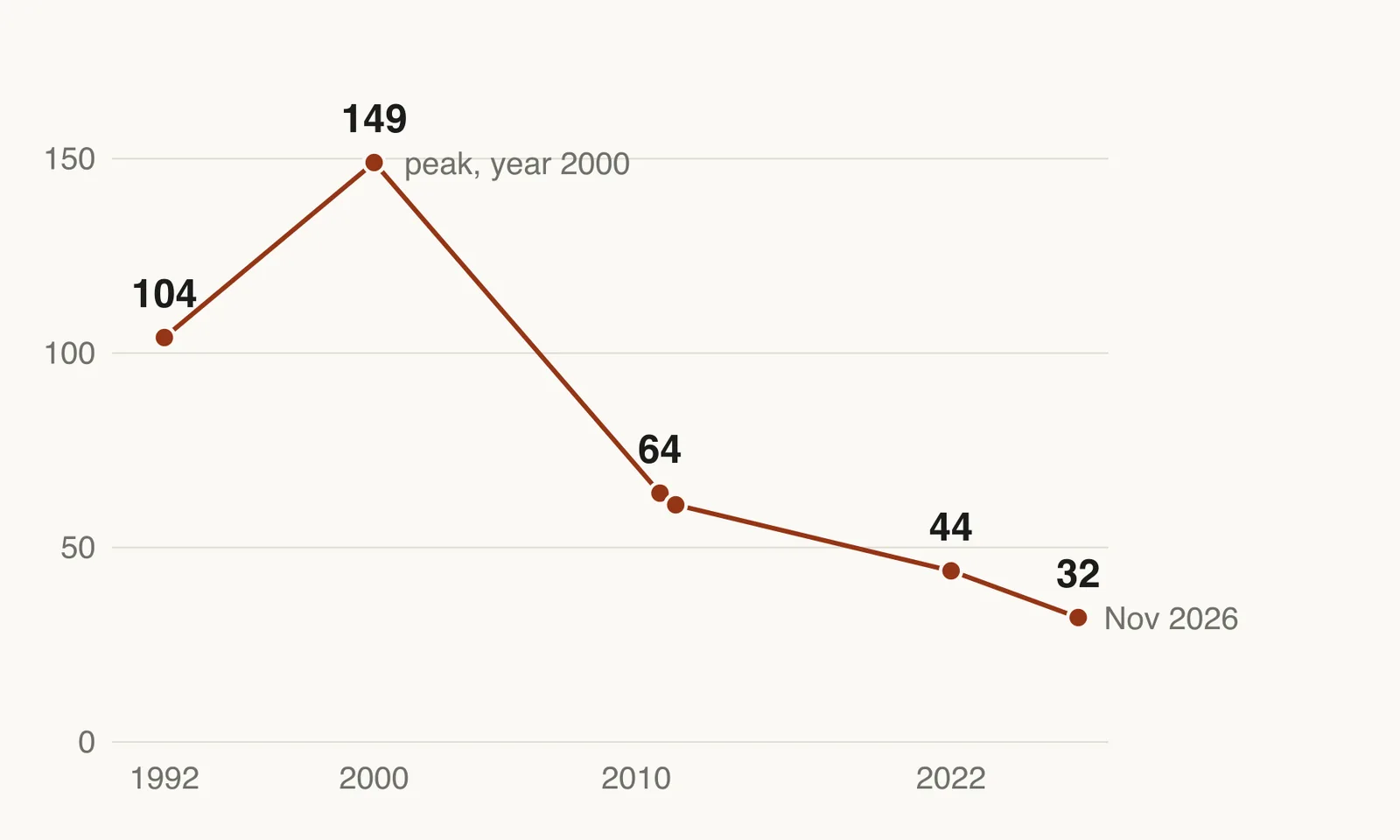
Active NASA astronauts at each reported count. Sources: NASA Inspector General, National Research Council, NPR.
Humans Were Not Built for This
In short
A round trip to Mars delivers about a full career's allowed radiation before you land. Bones thin by 1 to 1.5% a month. Two thirds of long-stay astronauts show eye and brain changes. Everything a crew needs has to be flown with them.
Take a human out of the only environment it evolved for and it starts to come apart.
The Curiosity rover carried a radiation detector on its way to Mars. It measured about 1.8 millisieverts a day in deep space, which works out to roughly 0.66 sieverts for the round trip, before a single day on the surface. NASA's limit for an astronaut's entire career is 0.6 sieverts. A 500-day stay on Mars would add about one more. In 2021 Francis Cucinotta, a physicist and former NASA radiation health officer, told Scientific American that on a Mars mission a 35-year-old woman right at that limit "could have an over 10 percent chance of dying in 15 to 20 years. To me, this is like playing Russian roulette with the crew."
Then there is the rest of the body. Astronauts on long missions lose 1 to 1.5% of their bone density every month. About two thirds of them come home with early signs of a syndrome that changes the shape of the eye and the brain. Muscles waste. Immune systems drift. And Mars is, on average, 140 million miles from the nearest hospital.
A rover has none of these problems. It does not need air, water, food, sleep, a toilet, a doctor, or a ride home. That last one matters most. Every kilogram you send to keep a person alive is a kilogram of science you did not send.
The Bill for Keeping Someone Alive
In short
One Artemis launch costs $4.1 billion. The entire Perseverance mission cost $2.7 billion. The space station costs about $3 billion a year to keep running.
This April, four astronauts flew around the Moon on Artemis II and came home safely. It was the first time a human being had left low Earth orbit since December 1972. Fifty-three years.
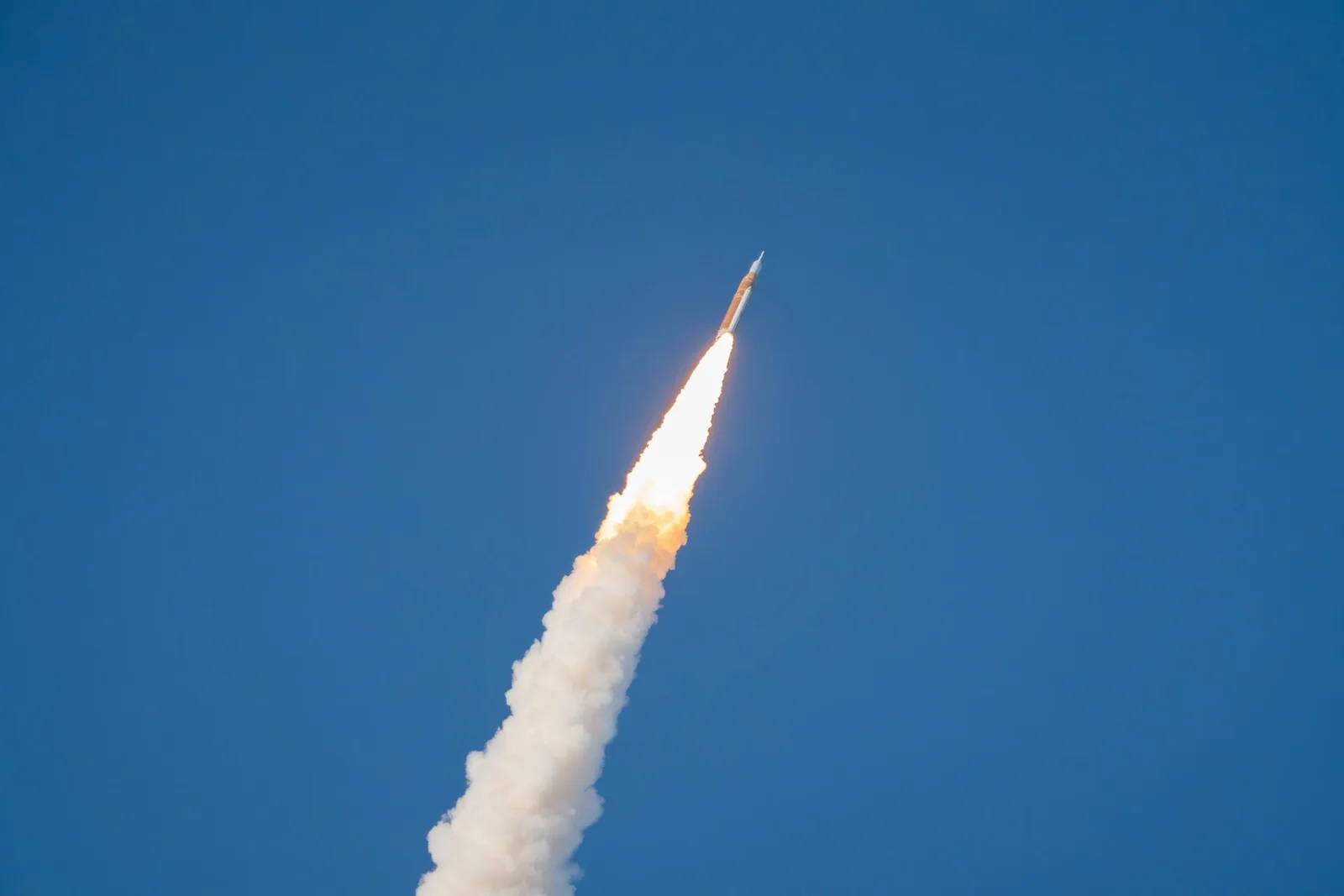
Artemis II lifts off on 1 April 2026 with four astronauts aboard. Photo: NASA/Brandon Hancock.
It was a real achievement, and it tells you everything. NASA's inspector general puts the cost of a single launch of that rocket and capsule at $4.1 billion, and the Artemis program at $93 billion through 2025. For that, nobody landed. The first landing is now planned for 2028.
For comparison, the Perseverance rover cost about $2.7 billion. Not per launch. For the whole thing: built, launched, landed and operated on Mars. It has been working there for more than five years.
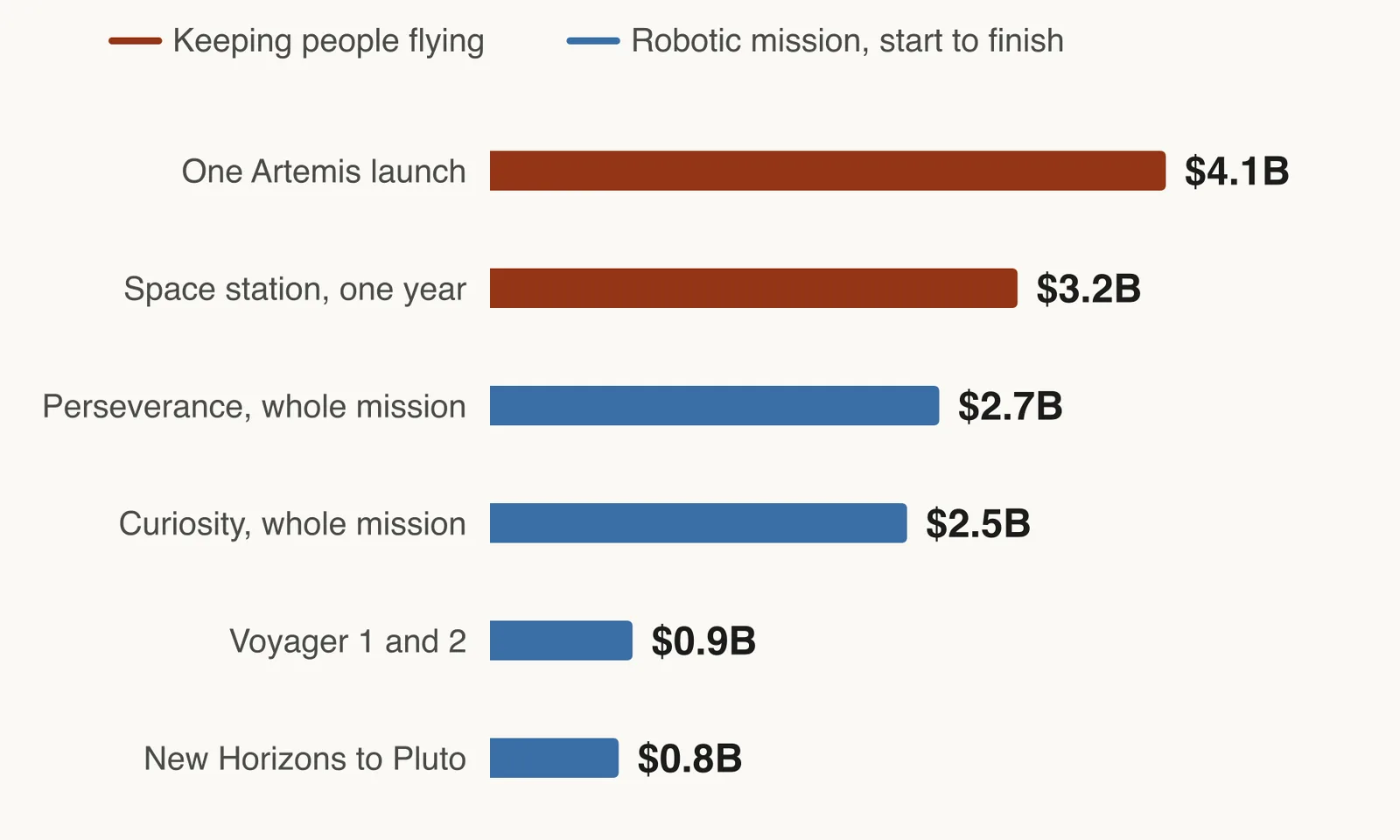
Reported costs in billions of US dollars, not adjusted for inflation. Sources: NASA Inspector General; The Planetary Society.
The International Space Station costs NASA roughly $3 billion a year to operate. Divide that by the crew on the American side and you get something like $2 million per astronaut, per day. These figures come from different years and are not adjusted for inflation, so treat them as scale, not as a ledger. The scale is the point.
We could be all over Mars right now. A fleet of rovers, helicopters, drills and orbiters, for the price of a few flights that carry people in a loop and bring them back.
Now Price a Trip to Mars
In short
NASA has never published a price for putting people on Mars. Outside estimates run from $87 billion for a trip that does not land to a trillion dollars for one that does. Everything NASA has ever spent on robots at Mars adds up to about $41 billion.
Start with a fact that should bother you. NASA has no official price for sending people to Mars. In 2017 its own inspector general wrote: "NASA has not developed a cost estimate for either the individual systems or the overall cost of its Journey to Mars."
So other people have done the sums.
- 1989. NASA's own 90-Day Study priced a programme to return to the Moon and go on to Mars at "approximately 500 billion dollars" over 20 to 30 years. Congress looked at the number and walked away.
- 2019. An independent study that NASA commissioned put a mission launching in 2037 at $87 billion. That mission orbits Mars. Nobody lands.
- 2017. Engineers at the Johns Hopkins Applied Physics Laboratory wrote that one landing "is likely to be about $1T." A trillion.
- The optimists. Advocates have argued it could be done for as little as $30 billion. Mars One said $6 billion. We know how that went.
Now the other side of the ledger. Add up every orbiter, lander and rover NASA has sent to Mars since 1960. The Vikings. Pathfinder. Spirit and Opportunity. Curiosity. Perseverance. All of it, adjusted for inflation, comes to about $41 billion.
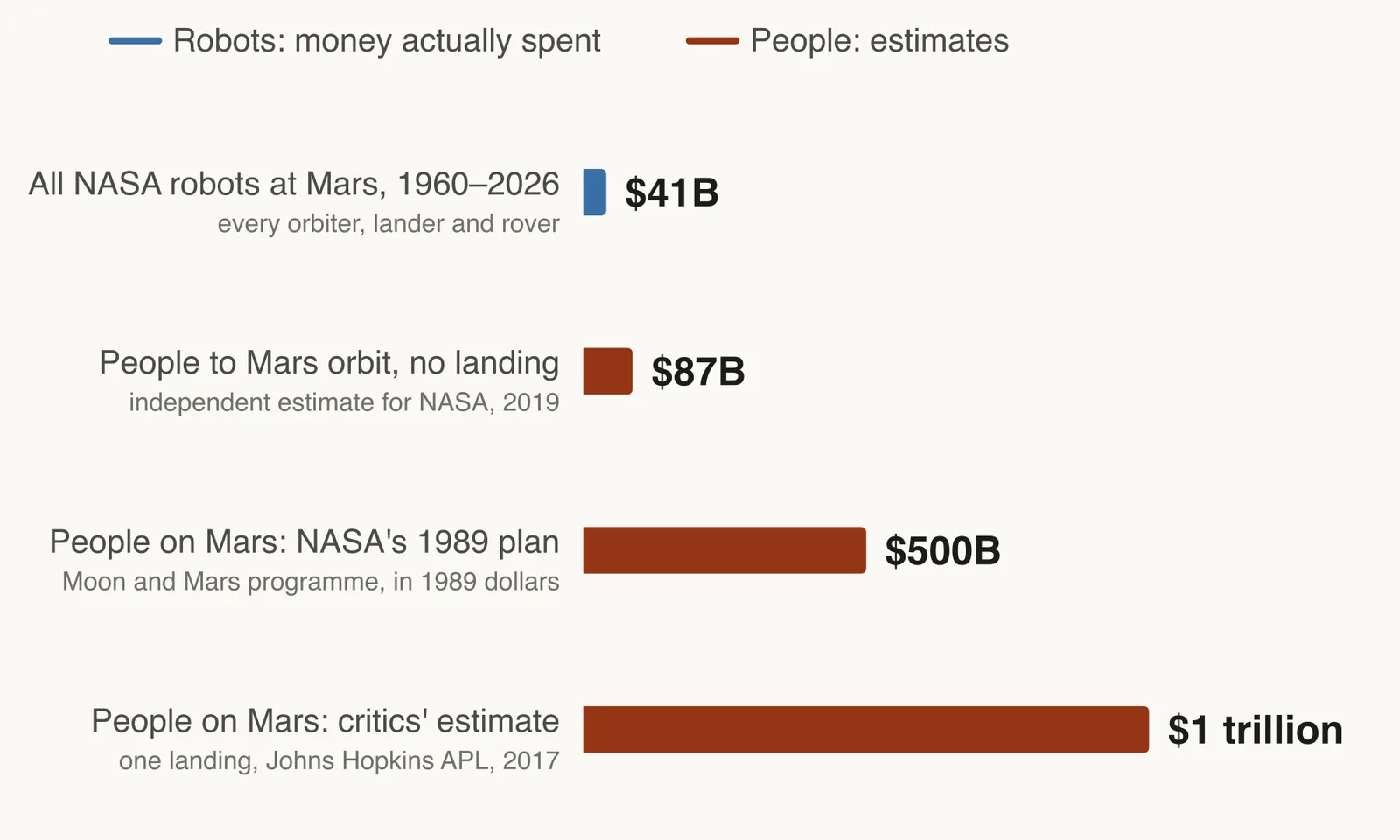
What has been spent on robots at Mars, against what sending people is estimated to cost. Sources: The Planetary Society; NASA; IDA Science and Technology Policy Institute; McNutt and Delamere, 2017. Dollar years differ.
Put those together. The cheapest serious estimate, the one where nobody even lands, is twice what we have spent on Mars robots in 66 years. The half-trillion figure would buy about 180 rovers like Perseverance. That is my arithmetic and it is rough, because the dollars come from different decades and one side is an estimate while the other is money already spent. Correct for inflation and the gap gets wider, not smaller.
The physicist Steven Weinberg, a Nobel laureate, put it in one sentence in 2012: "For the $1 trillion cost of sending human beings to Mars, perhaps to just one location on Mars, we could have unmanned rovers wandering all over the planet."
One hundred and eighty rovers. Or one flag.
The Only Reason We Sent People Is Disappearing
In short
The case for astronauts was judgement on the spot. Rovers now drive themselves, and last December an AI planned a Mars drive for the first time.
The honest argument for astronauts was never romance. It was that a person on the spot can look, think and decide, and a robot has to wait for instructions. A radio signal takes between 4 and 20 minutes to reach Mars. You cannot steer a rover with a joystick from Earth.
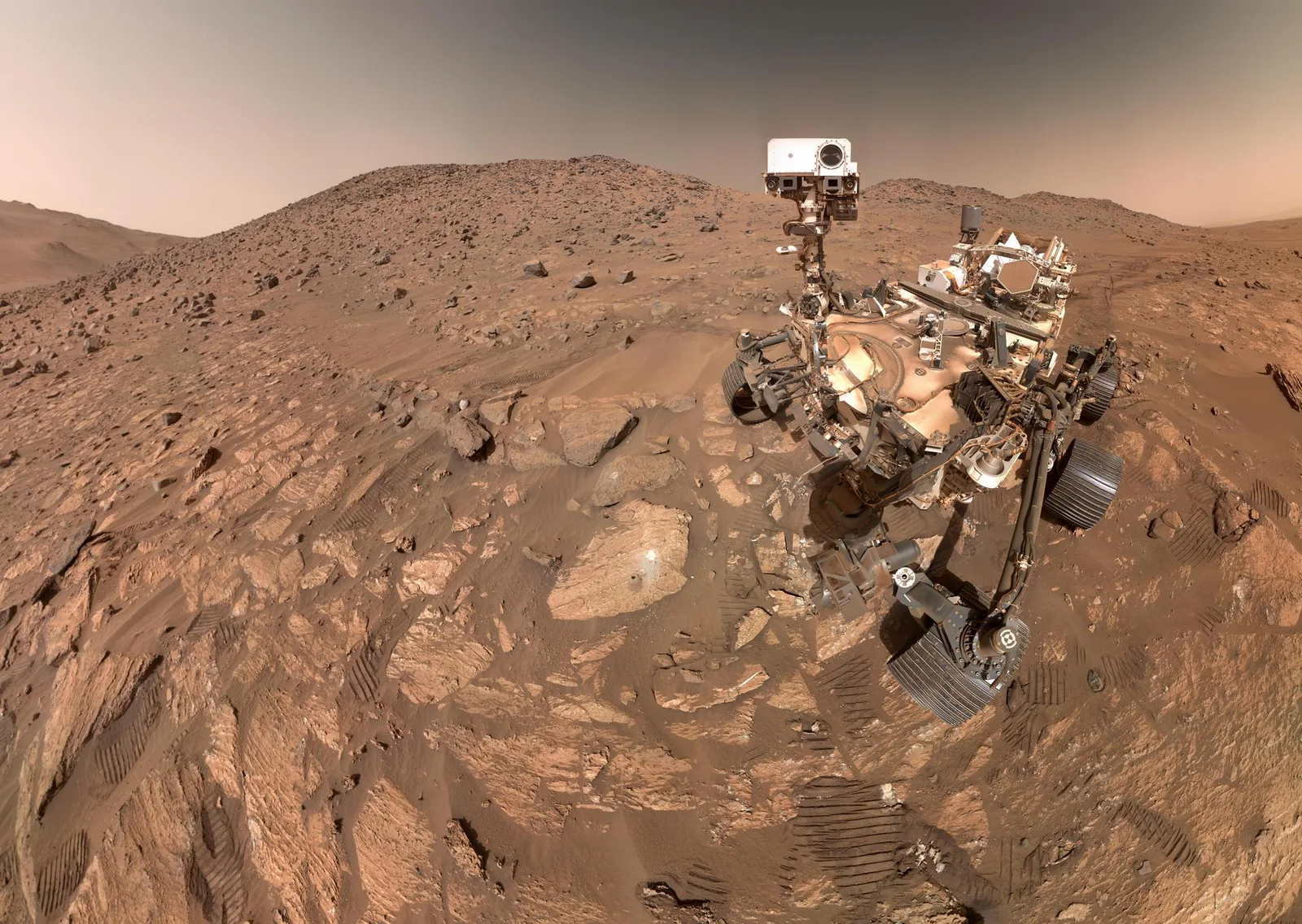
Perseverance photographed itself on Mars in July 2024. Nobody was there to hold the camera. Photo: NASA/JPL-Caltech/MSSS.
So the rovers learned to steer themselves. Perseverance has driven more than 90% of its distance on its own navigation. This October it passed the record for the longest drive on another world, 45 kilometres, and did in five and a half years what took an earlier rover almost fifteen.
Last December it went a step further. For the first time, a drive on another planet was planned not by engineers but by an AI model, working from orbital images. Two drives, 210 and 246 metres. Small. So was the first flight at Kitty Hawk.
This is the direction of travel. I see more AI every month and better robots every year. The thing we used to need a human for, judgement at the far end of a long delay, is exactly the thing machines are getting good at. And unlike us, they improve with every software update.
The Dream of Living on Mars
In short
Mars One collected application fees for a one-way trip and went bankrupt. Elon Musk has named six different dates for people on Mars, and this year he turned to the Moon instead.
There is a stubborn idea that the real goal is to move there. To live on another planet. I think it is a silly dream, and the record of the people selling it does not help.
Mars One announced a one-way trip to Mars. No return ticket. It invited the world to apply and charged an application fee that ranged from $5 to $73 depending on your country. The company boasted of 202,586 applicants. Its own chief medical officer later admitted that the number of completed applications was 4,227.
Researchers at MIT ran the plan through an engineering analysis in 2014. Their finding: the first settler would suffocate after about 68 days. The first landing was promised for 2023, then 2025, then 2027, then 2031. On 15 January 2019 a court in Basel declared the company bankrupt, with debts of about a million euros. Nobody went anywhere. Critics called it a suicide mission. They were being generous. A suicide mission at least leaves the ground.
Elon Musk is a more serious figure with a real rocket company, and the same pattern. In 2016 he hoped to launch a crew in late 2024. In 2017, still 2024. In 2020, about 2026. In 2022, 2029. In 2024, 2028. In 2025, 2029, "although 2031 is more likely."
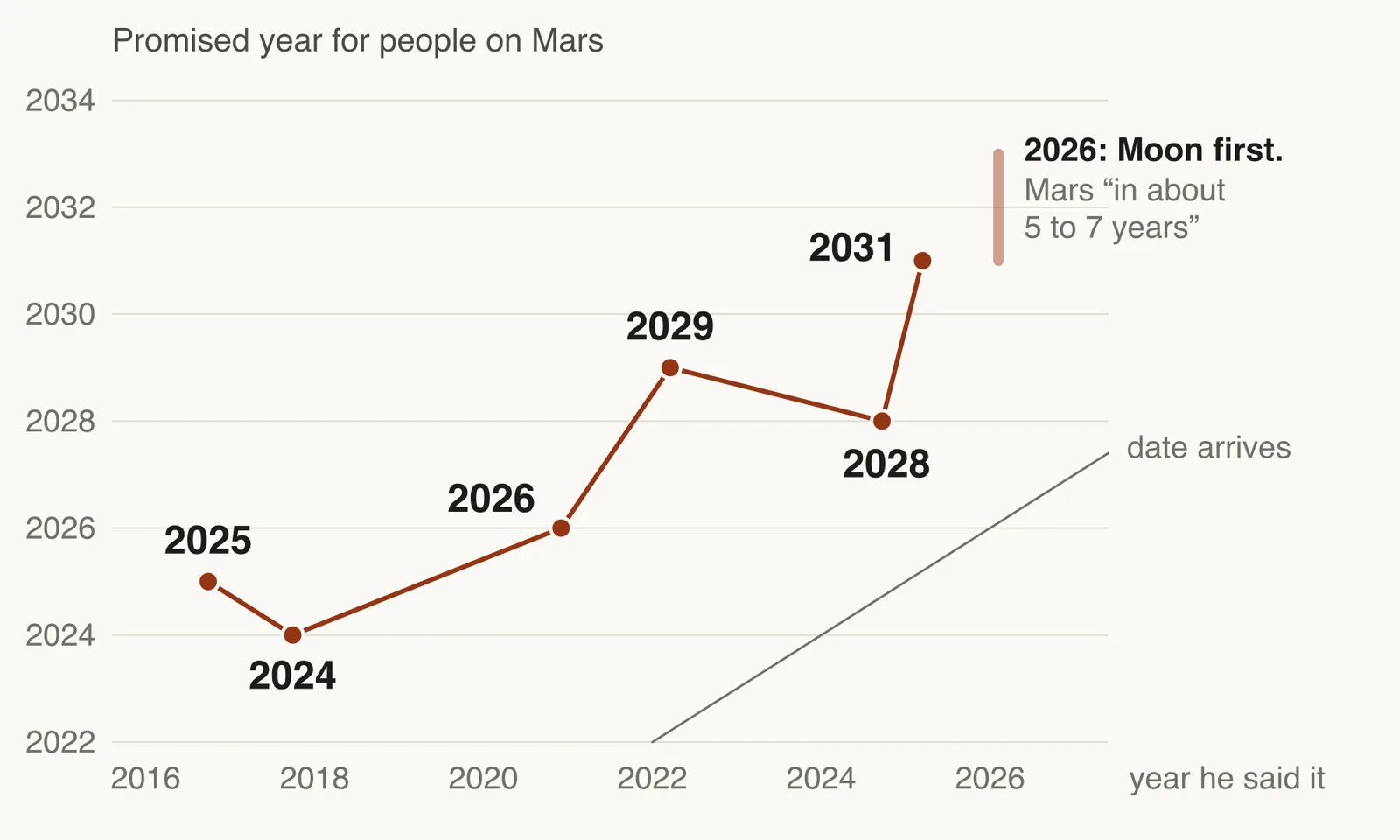
Each dot is a year Elon Musk named for the first people on Mars, placed at the year he said it. Sources listed below.
Then, this February, he wrote that SpaceX "has already shifted focus to building a self-growing city on the Moon," and that work on a Mars city would begin "in about 5 to 7 years." The Wall Street Journal reported that the Mars flight planned for this year had been put off. The plan was not cancelled. It just did what it always does. It moved.
And notice what his own 2025 plan put on the first ship to Mars. Not people. Robots.
What the Other Side Gets Right
In short
A geologist on Mars would outwork any rover, more people are flying than a few years ago, and robotic missions get cancelled too. None of it changes the direction.
I am not going to pretend there is no case for astronauts. There is, and it is better than its fans usually make it.
Steve Squyres, who ran the Spirit and Opportunity rovers, wrote that most of what his rovers could do in a perfect day on Mars, "a human explorer could do in less than a minute." One researcher worked that out as people being about 1,500 times more efficient in the field. Twelve astronauts spent twelve and a half days on the Moon and we are still publishing papers from what they brought back.
More people are flying, too. Only nine people reached orbit in 2018, and nine again in 2019. Last year it was 28. China keeps a space station permanently crewed. And machines do not always win the budget fight: this year Congress closed down NASA's program to bring Mars rock samples home.
All true. But look at what each point actually says. A human would be faster, if you could get one there alive and afford to do it more than once a generation. More people fly, mostly to the same station 400 kilometres up, many as customers. And the Squyres comparison was written in 2005, about rovers that could barely drive themselves. The human body has not improved since then. The robots have.
Our Turn Is Over. Step Aside.
In short
Sending people was a phase, like sending dogs and monkeys. Empty the space station, build stations and a Moon base for machines, and let anyone who still wants to go buy their own ticket.
We did not start with people. In 1949 the United States put a monkey called Albert II on a rocket. In November 1957 the Soviet Union put a dog called Laika into orbit. In January 1961 a chimpanzee named Ham flew a Mercury capsule, weeks before the first human went up.
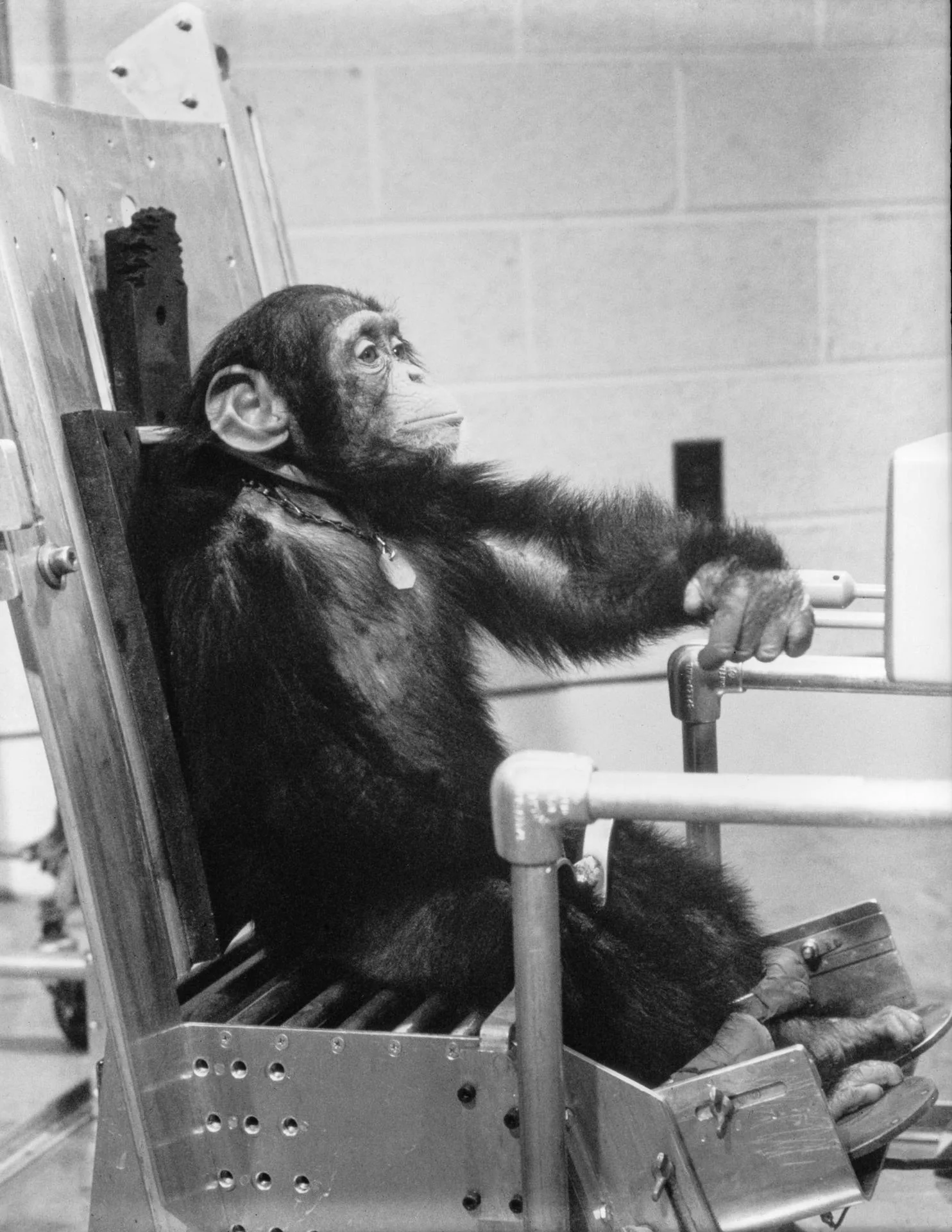
Ham before his Mercury-Redstone 2 flight on 31 January 1961. He went up before any astronaut did. Photo: NASA.
Nobody thinks we should still be launching dogs. The animals were a stage. They answered a question, can a living thing survive up there, and once it was answered we stopped. I think the astronaut was a stage too. It was a novelty to have humans in space, just as it was to have dogs and monkeys. Everything has its turn, and ours is done.
So finish the thought.
Empty the space station. People have lived on it without a break since 2 November 2000. It is due to be retired at the end of 2030. NASA's own inspector general found that each astronaut on the American side gets about twelve hours a week for research. The rest goes to keeping the station, and themselves, alive. That is a three-billion-dollar-a-year laboratory running at part-time hours. The next stations should not have a crew at all. No air to recycle, no toilet to fix, no one to rescue. Just instruments and robotic arms, working every hour of every day.
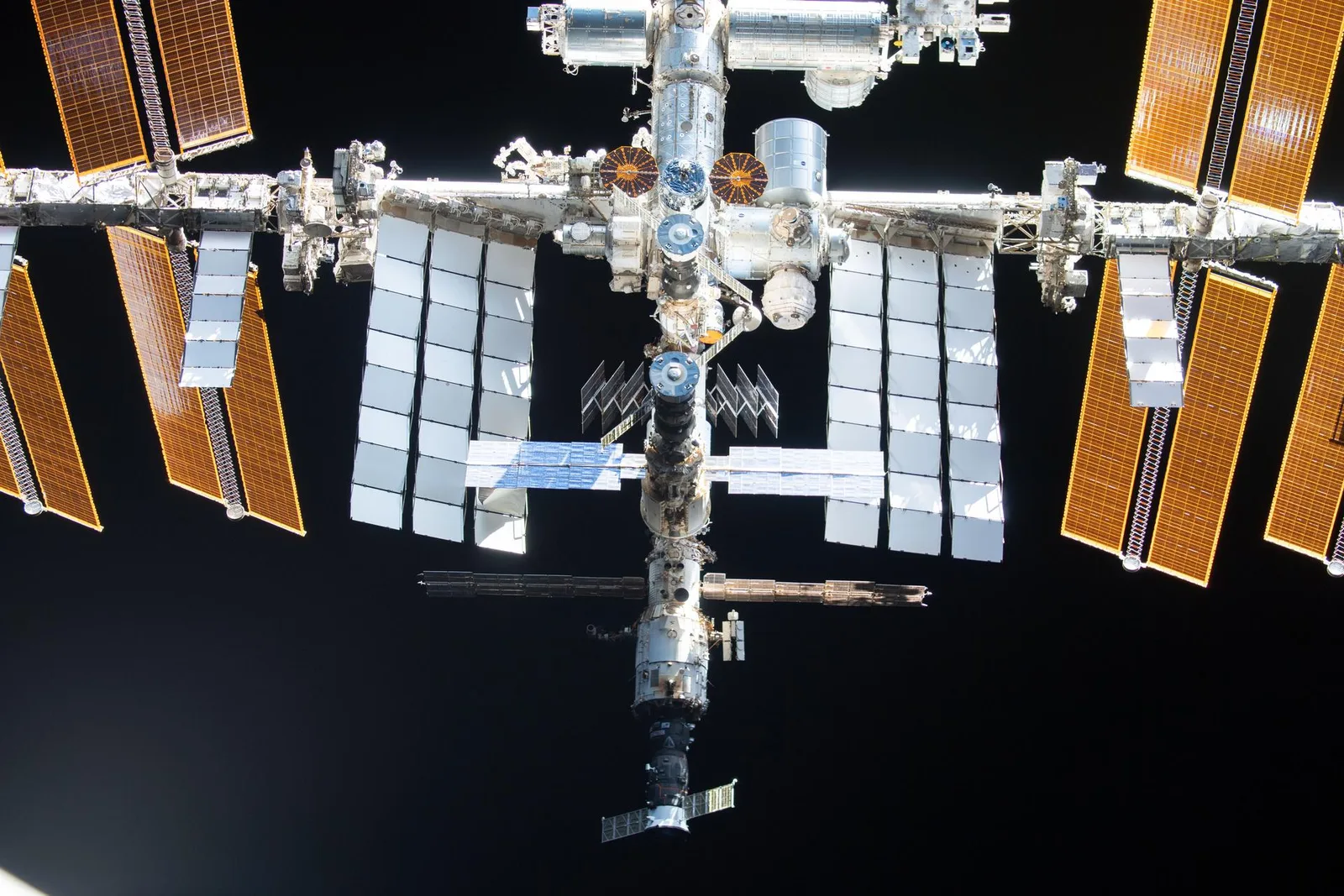
The International Space Station in November 2021, photographed from a departing Crew Dragon. Photo: NASA.
Build the Moon base for machines. Not a village with a flag. A worksite. Robots that dig, build, mine ice, make fuel and repair each other, run from Earth with a signal delay of little more than a second. Everything a human base would need to exist first has to be built by machines anyway. So skip the part where we risk people to watch.
And let the people who still want to go pay for it. Private passengers have already taken 24 seats to orbit since 2021. NASA's own cost for a seat on the same capsule has been put at about $55 million. Good. If someone rich wants to see the curve of the Earth, that is tourism, and tourism can pay its own way. It just should not be mistaken for exploration, and it should not be billed to everyone else.
This is not giving up on space. It is the opposite. We learn more about the universe by getting out of the way. Every billion spent keeping four people alive for ten days is a billion not spent on the machines that are actually doing the exploring.
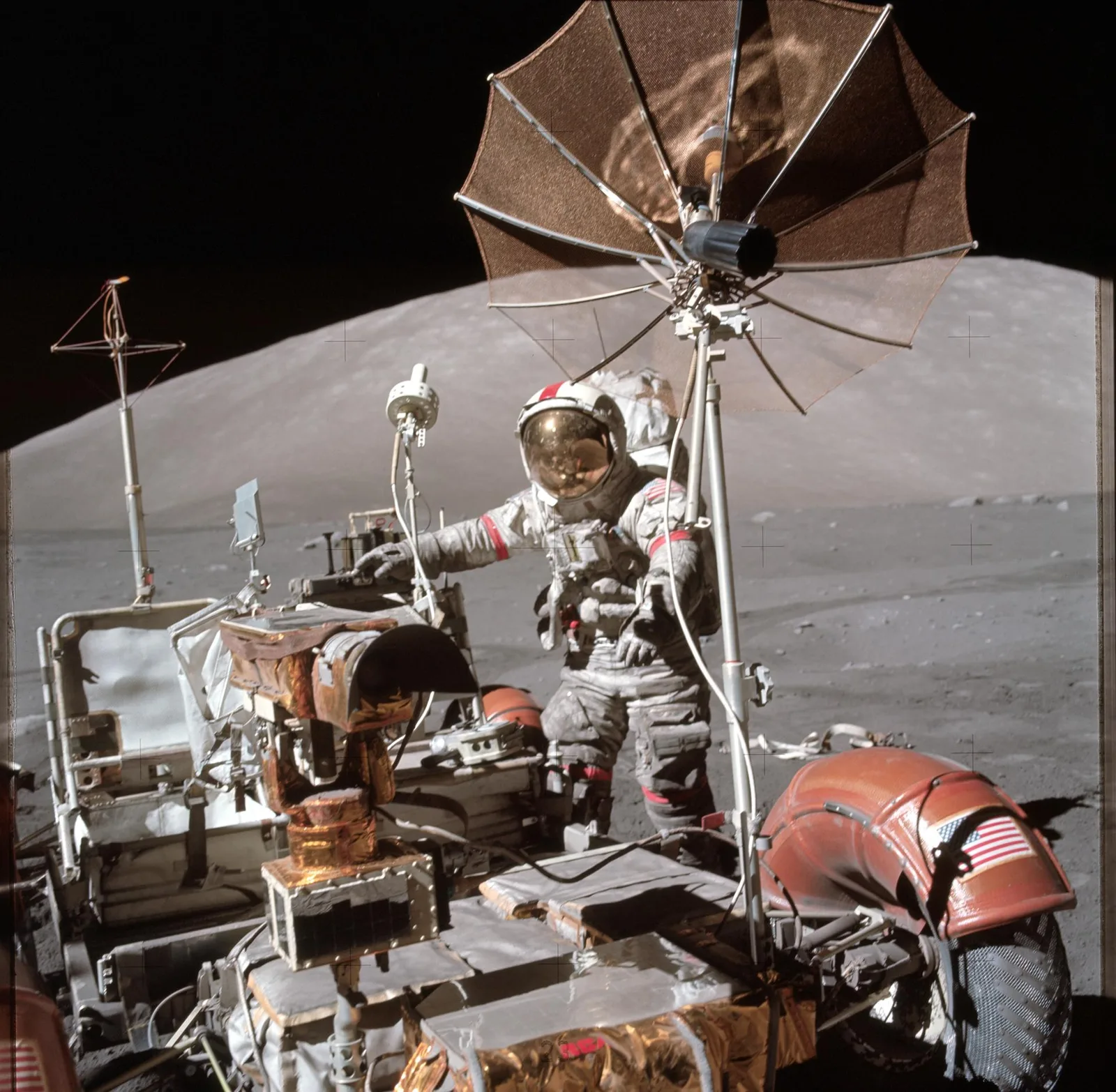
Eugene Cernan beside the lunar rover, December 1972. Nobody has stood there since. Photo: NASA.
The last person to walk on the Moon left in 1972. Since then, machines have landed on Mars, Venus, Titan, a comet and several asteroids, flown past every planet, and crossed into interstellar space twice. We already made the choice. We just have not admitted it.
Sources
- Launch and crew counts: Jonathan McDowell, General Catalog of Artificial Space Objects and annual human spaceflight statistics. 2026 figures run to 8 November.
- Astronaut corps: NASA Inspector General IG-22-007; NASA active astronauts.
- Artemis II: NASA mission page. Costs: NASA Inspector General IG-22-003.
- Robotic mission costs: The Planetary Society, cost of Perseverance and New Horizons.
- Radiation: Southwest Research Institute; NASA radiation protection brief; Scientific American, 2021.
- Bone loss and eye changes: NASA Human Research Program, evidence report and 2023 clinical update.
- Rover autonomy: JPL, distance record and first AI-planned drive.
- Mars One: IBTimes UK; MIT study release; NPR via KPBS; New Atlas.
- Musk's Mars dates: Spaceflight Now, 2016; The Planetary Society, 2017; SpacePolicyOnline, 2026.
- Space station crew time and seat prices: NASA Inspector General IG-20-005. Station history and retirement date: International Space Station.
- Animals in space: dates and missions.
- Cost of sending people to Mars: NASA Inspector General IG-17-017; NASA history of the Space Exploration Initiative; STPI study, reported by SpacePolicyOnline; McNutt and Delamere, 2017. Robotic Mars spending: The Planetary Society, Planetary Exploration Budget Dataset. Weinberg quote: Voice of America, 2012.
- The case for humans: Ian Crawford, "Dispelling the myth of robotic efficiency", 2012.