Have you ever wondered how websites can instantly tell if a credit card number is valid—without even contacting the bank? It looks like magic. It's a simple checksum. In this post, we’ll break down how credit card validation works, show you an example, and introduce you to a free tool where you can test it yourself.
🔍 The Secret Behind Credit Card Validation
When you type in your card details on a website, most systems use the Luhn algorithm (also called the “modulus 10” or “mod 10” algorithm). This clever math trick lets computers quickly check whether a card number could be real, based on its structure and a check digit, without talking to any servers or banks.
This is perfect for catching typos and invalid entries—saving time for both users and developers.
How the Luhn Algorithm Works, Step by Step
- Start at the rightmost digit (the check digit) and move left.
- Double every second digit. If doubling gives a number over 9, subtract 9.
- Add up all the digits, doubled and untouched.
- If the total ends in 0 (divisible by 10), the number passes.
Take the test number 4024 0071 8284 5072. After step 2 the digits become 8 0 4 4 0 0 5 1 7 2 7 4 1 0 5 2. They add up to 50, which ends in 0, so the number passes. Change the last digit to 5 and the total becomes 53, so it fails. That's exactly the pair the tool shows below.
Where the Luhn Check Came From
The formula is named after Hans Peter Luhn, an IBM scientist. His patent for a "Computer for Verifying Numbers" (US 2,950,048) was issued in August 1960. Today it is written into ISO/IEC 7812-1, the international standard for card numbering, so every major card network uses the same check.
It also shows up far outside payments: phone IMEI numbers, SIM card ICCIDs, Canadian Social Insurance Numbers and US National Provider Identifier numbers all use it.
What It Catches (and What It Misses)
Luhn was built to catch the mistakes humans actually make when typing:
- Every single wrong digit. Type 4111 1111 1111 1112 instead of 4111 1111 1111 1111 and the total jumps from 30 to 31. Fail.
- Almost every swap of two neighboring digits. Flip the "07" near the end of 4024 0071 8284 5072 to "70" and the number fails.
- Most "twin" errors, like typing 11 when you meant 22.
It is not perfect. Swapping 09 for 90 (or the reverse) slips through, and so do the twin errors 22↔55, 33↔66 and 44↔77. That's fine: it's a typo filter, not a lock.
The Code: Ten Lines of Python
Here is the whole check. It ignores spaces and dashes, so users can paste numbers however they like.
def luhn_valid(number: str) -> bool:
    digits = [int(c) for c in number if c.isdigit()]
    total = 0
    for i, d in enumerate(reversed(digits)):
        if i % 2 == 1:      # every second digit from the right
            d *= 2
            if d > 9:
                d -= 9
        total += d
    return total % 10 == 0

luhn_valid("4111 1111 1111 1111")  # True
luhn_valid("4111 1111 1111 1112")  # False
Two things trip people up. First, you count from the right, because card numbers are not all the same length. Second, a real form should also check the length and prefix (below) and reject an empty string, which this bare function would happily call "valid."
Note
Passing the Luhn check only means a number is well-formed. It says nothing about whether the account exists, has money, or belongs to the person typing it. Only the card network can tell you that.
💳 Test and Learn: Try Credit Card Validation Yourself
The folks at this validation tool provide a step-by-step explanation using real examples. You can even type in your own test numbers to see how the system responds.
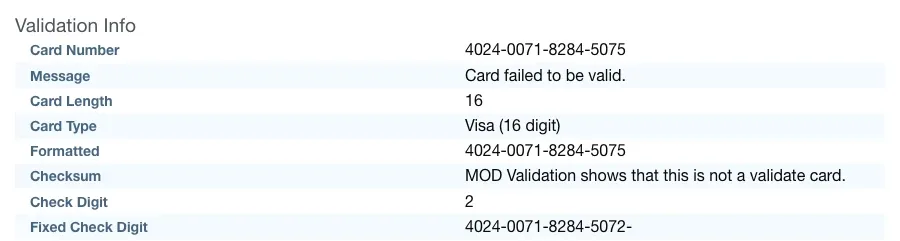
Here’s an example I tried:
Test Number: 4024-0071-8284-5075
Result: Card failed to be valid.
Card Type: Visa (16-digit)
Checksum: MOD validation failed.
The tool even suggested a “fixed” number for testing:
Fixed Number: 4024-0071-8284-5072
Result: Validated successfully!
🔗 Why This Matters for Developers and Testers
As a developer, testing your payment system with multiple card types is crucial. This tool helps you:
Key takeaways
- ✅ Validate user input before sending it to a payment processor.
- ✅ Generate test card numbers for Visa, MasterCard, and AMEX.
- ✅ Avoid accidental fraud or using live data during testing.
Warning
Remember, these generated numbers are only for testing. They won’t process actual payments but are perfect for building robust systems.
🤔 Did You Know? Fun Credit Card Facts
- 💡 The leading digits (the issuer identification number, or IIN, which people still call the BIN) say who issued the card. Visa starts with 4. Mastercard uses 51–55 and, since the late 2010s, 2221–2720. American Express uses 34 and 37.
- 💡 Lengths differ too: Amex numbers are 15 digits, Mastercard 16, and Visa can be 13, 16 or 19. Card numbers top out at 19 digits.
- 💡 The IIN grew from six digits to eight under the 2017 edition of ISO/IEC 7812-1, so don't hard-code "first six digits" into new code.
- 💡 The last digit is a check digit calculated from all previous digits using the Luhn algorithm.
Quick FAQ
Can a Luhn-valid number still be fake? Yes. About one in ten random digit strings passes. Passing just means "no obvious typo."
Which numbers should I use for testing? Your payment processor's published test cards. Stripe, for example, lists 4242 4242 4242 4242 (Visa), 5555 5555 5555 4444 (Mastercard) and 3782 822463 10005 (Amex). Stripe's terms prohibit testing in live mode with real card details, so never use your own card.
Should I run Luhn on the server too? Yes. Browser checks are for user comfort; anyone can skip them.
📌 Final Thoughts
Understanding credit card validation helps users avoid frustration and developers build smarter apps. Next time you see a quick “invalid card” error, you’ll know exactly what’s happening behind the scenes.
Need test data to go with it? The fake profile generator creates Luhn-valid test cards, and the contact and address generator fills in realistic names and addresses.
Sources
- Wikipedia, "Luhn algorithm" (inventor, US patent 2,950,048, errors detected and missed, other uses): https://en.wikipedia.org/wiki/Luhn_algorithm
- Google Patents, US 2,950,048 "Computer for Verifying Numbers": https://patents.google.com/patent/US2950048A/en
- ISO, "Changes to the Issuer Identification Number (IIN) standard" (2016): https://www.iso.org/news/2016/11/Ref2146.html
- Wikipedia, "Payment card number" (IIN ranges and lengths): https://en.wikipedia.org/wiki/Payment_card_number
- Stripe, "Testing" (test card numbers, no real card details): https://docs.stripe.com/testing