
You have probably had this experience. Someone puts on a hit comedy from Spain or Mexico. The room is crying with laughter. You are reading the subtitles, you understand every word, and you have no idea what is funny.
You are not missing a sense of humour. You are not imagining it either. The numbers say almost nobody outside the Spanish-speaking world gets these jokes, and they say it loudly.
Meanwhile a British man who barely speaks has made people laugh in 195 territories. Here is why the joke travels in one direction.
You're Not Imagining It
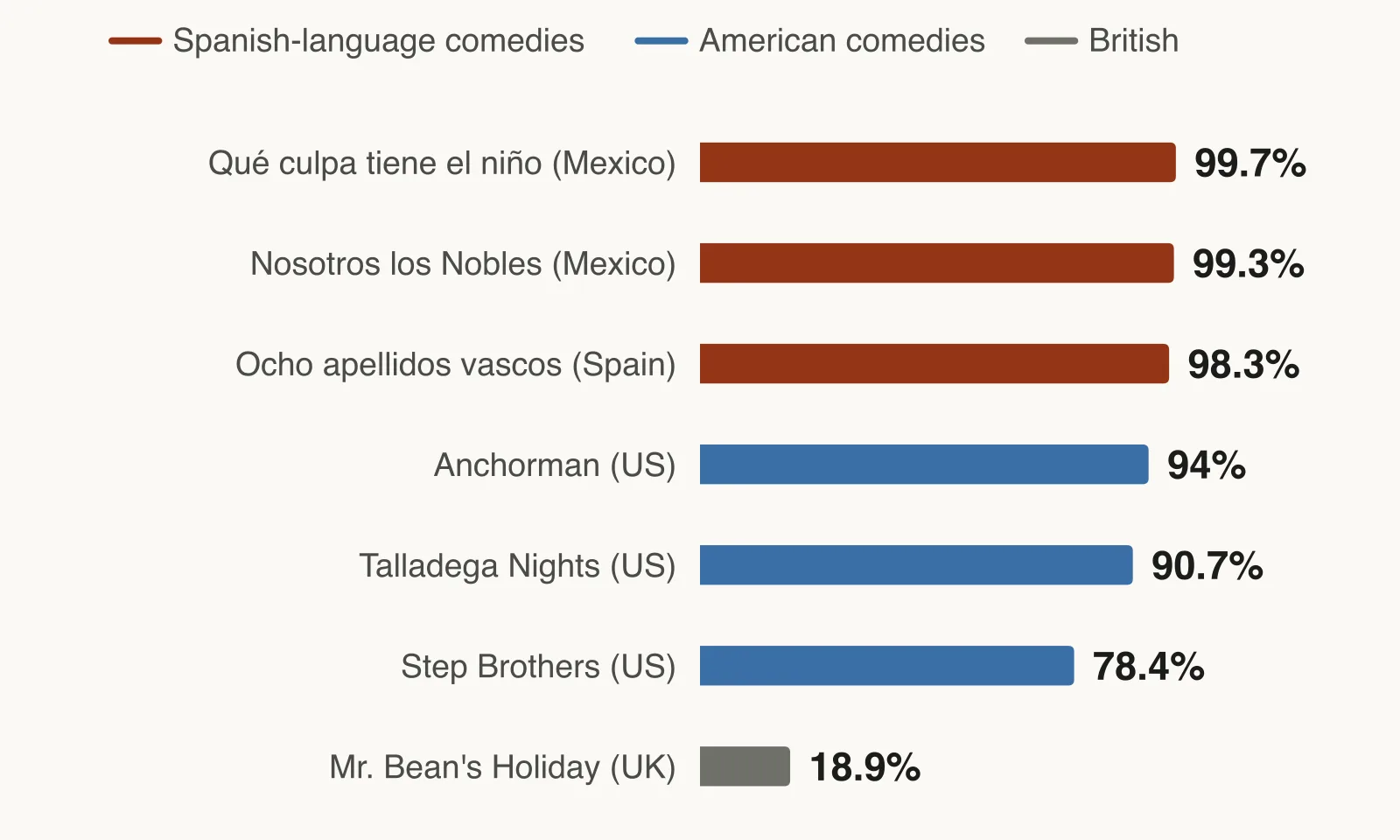
Start with the biggest film in Spanish history. Ocho apellidos vascos (2014), sold abroad as Spanish Affair, is a romantic comedy about a man from Seville pretending to be Basque to win over a woman from the Basque Country. It took $78.8 million worldwide. Of that, $77.5 million came from Spain: 98.3%.
Everything outside Spain, every other country on earth, paid $1.3 million. All of Latin America together paid $945,000. Germany paid $182,000. It never opened in the United States at all.
The sequel did the same thing, only more so: 99.3% of its money came from Spain. Mexico's comedy hits look identical from the other side of the Atlantic. Nosotros los Nobles (2013) earned 99.3% of its money in Mexico. ¿Qué culpa tiene el niño? (2016) earned 99.7%.
Now compare the Hollywood comedies everyone agrees are "too American to travel". Anchorman earned 94% of its money in the United States and Canada. Talladega Nights, a film about NASCAR, earned 90.7% at home. Those are famous international flops, and they still earned 6% to 22% abroad. The biggest Spanish-language comedies earn 0.3% to 1.7%.
In short
The biggest Spanish and Mexican comedies earn 98% to 99.7% of their money at home. Even "too American" Hollywood comedies earn more abroad than that.
Meanwhile, English Comedy Is Everywhere
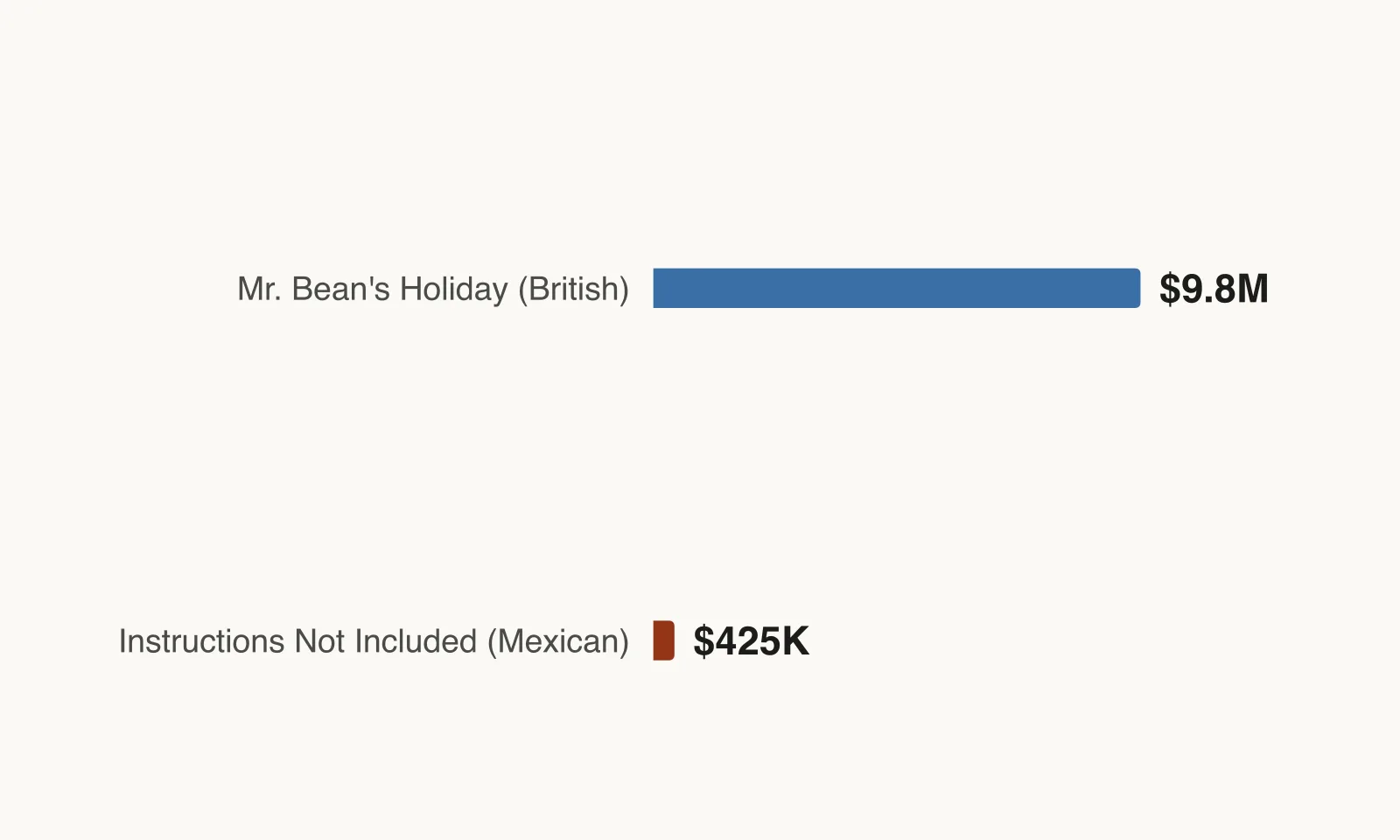
Now look at a comedy that travels. Mr. Bean's Holiday (2007) earned 85.7% of its money outside the United States and Canada: $198.9 million. Germany paid $25.1 million for it. Spain paid $9.8 million.
Put that next to Mexico's greatest comedy success. No se aceptan devoluciones (Instructions Not Included, 2013) earned $100.5 million worldwide, a huge hit by any standard. Spain, a country that speaks the same language, paid $424,553 to see it. Spain spent about 23 times more on a near-silent Englishman than on the biggest Mexican comedy of the decade.

Rowan Atkinson in London, 2009. The face that sold a comedy to 195 territories. Photo: Glenn Standish, CC BY-SA 3.0.
Mr. Bean is not a one-off. The company that owns the show says it has aired in 195 territories. British comedy formats get rebuilt around the world: The Office has local versions in about 15 countries, from Chile to Israel to Saudi Arabia. Britain sold £2.02 billion of television abroad last year.
The traffic in the other direction is a trickle. There are a few Spanish-language hits that cross over, but they are thrillers, not comedies. More on that below.
In short
Spain paid 23 times more for Mr. Bean than for Mexico's biggest comedy. English comedy is an export industry. Spanish-language comedy mostly isn't.
The Joke Is Inside the Words
Much of the best-loved Spanish-language humour lives inside the language itself. You can translate the words. You cannot translate the trick.
Take the albur. The official dictionary of the Spanish-language academies defines it as a game of double-meaning wordplay "with frequent sexual suggestions". In Mexico it is practically a sport: two people trade sentences that sound innocent and are anything but, and the winner is whoever gets the last double meaning in. Luis Fernando Lara, who directs the dictionary of Mexican Spanish at El Colegio de México, calls it "apparently a Mexican phenomenon". His team tested AI chatbots on it. The machines did not understand the double meaning. If software trained on half the internet cannot catch an albur, a subtitle has no chance.
Then there is Cantinflas, the most famous Mexican comedian who ever lived. His act was talking: a torrent of fluent, confident sentences that went in circles and arrived nowhere. He was so good at it that his name became a verb. Cantinflear, in the academies' dictionary of the Americas, means to speak in an incoherent, rambling way without saying anything of substance, and it is used in nine countries.
Cantinflas even won a Golden Globe, for Around the World in 80 Days (1956). Hollywood then built a film around him, Pepe (1960). It flopped and he went home to Spanish-language films. An admiring museum profile put the problem plainly: his humour was "difficult to translate for an English-speaking audience." Of course it was. The joke was the Spanish.

Cantinflas arriving at Madrid's Barajas airport in November 1964. Photo: Iberia Airlines, CC BY 2.0.
In short
Albures and Cantinflas are jokes made of grammar and double meanings. Translate them and the joke disappears.
The Joke Is Inside the Country
The second problem is that the punchline often needs a map.
Ocho apellidos vascos is ninety minutes of jokes about how people from Andalusia and people from the Basque Country see each other: accents, food, family, stubbornness. If you grew up in Spain, every scene lands twice. If you didn't, it is a pleasant romantic comedy with an awful lot of shouting. Even the title, "eight Basque surnames", is a joke about family pedigree that almost no foreigner will get.
Spain has a whole tradition like this. Chiquito de la Calzada, one of the country's best-loved comedians, made catchphrases out of words he invented, like fistro, a noise that means nothing and became one of the country's best-known catchphrases. La Codorniz, a Madrid humour magazine that ran from 1941 to 1978, built a style one Spanish paper describes as baffling, absurd and surreal. These are brilliant things to have grown up with. They are close to impossible to export.
Mexico's El Chavo del Ocho is the best proof that local comedy can still be enormous. The sitcom about a poor kid living in a barrel was broadcast across about twenty countries until 2020. Brazil showed a Portuguese dub, Chaves, for 36 years straight. Yet there was never a successful English version of the live-action show. It conquered its own language world, and stopped at the edge of it.

Handprints and signature left by Roberto Gómez Bolaños, "Chespirito", creator and star of El Chavo del Ocho, in Lima, Peru, in July 2008. Photo: RockSkaPunkMetal, CC BY-SA 4.0.
In short
Much Spanish comedy is built on regional stereotypes and shared memories. Without the local knowledge, there is no punchline.
Dubbing Rewrites the Joke Anyway
Here is the part English speakers rarely notice. When Spanish speakers laugh at Hollywood comedies, they are often laughing at jokes rewritten by one of their own comedians.
Hollywood comedies reach much of the Spanish-speaking world in dubbed versions, and the best dubbers do far more than translate. Eugenio Derbez, the Mexican comedian who voices Donkey in the Latin American version of Shrek, helped adapt the first film's script. When he was asked back for Shrek 5, he set one condition: "I made it a condition that they let me adapt the script." Donkey in Mexico City does not tell the same jokes as Donkey in Los Angeles. He tells funnier ones, for that audience.
The Simpsons work the same way. Humberto Vélez, the classic Latin American voice of Homer, became so loved that the show itself invited him to appear in an episode in December 2025.
So English comedy arrives in the Spanish-speaking world already translated by a local comedian, in the local slang. Spanish-language comedy almost never gets that treatment going the other way, because most of it is never released in English-speaking countries in the first place.
In short
Hollywood comedy reaches Spanish speakers after local comedians rewrite it. Spanish comedy rarely gets the same help in English.
The Exception That Proves the Rule
There is one Spanish-language comedy that conquered the American box office. Instructions Not Included is the highest-grossing Spanish-language film ever released in the United States: it passed Pan's Labyrinth in its fifth weekend and finished with $44.5 million in the US and Canada.
Look at what it is. Eugenio Derbez again, this time as a hopeless playboy raising a little girl left on his doorstep. It is sentimental, physical and built around a father and a child, the most universal story in the business. And look at where the money came from: Mexico plus the US and Canada made up 90% of its gross, and in the US its distributor aimed squarely at Spanish-speaking audiences. Outside the US, every market where Spanish is not the main language combined, from Brazil to Italy to Russia, added up to 0.47%.
The same pattern shows up on Netflix. The most-watched non-English titles of all time are thrillers, survival films and heists, including Spain's Money Heist, whose fourth part drew 106 million views in its first three months. By our count, none of the top 20 is a comedy. The best recent Spanish-language comedy run we found, Argentina's Envious, peaked at No. 3 on Netflix's global non-English TV chart with 2.8 million views in a week. A good week for a comedy. A rounding error next to a heist.
In short
When Spanish-language entertainment goes global, it is drama and thrillers. Even the biggest comedy crossover sold almost entirely to Spanish speakers.
What the Other Side Gets Right
It would be too easy to stop here, so let's be fair.
First, a lot of this is distribution, not taste. Hollywood studios push their comedies into every cinema on earth. Many Spanish and Mexican comedies never get a release in the United States, Britain or Germany at all. You cannot laugh at a film that never opened near you.
Second, English speakers do not share one sense of humour either. In a YouGov survey, 68% of Britons said "with the greatest respect" means "I think you are an idiot". Only 40% of Americans did. The world's biggest joke experiment, LaughLab, found the British, Irish, Australians and New Zealanders loved wordplay, while Americans and Canadians preferred jokes where someone looks stupid. Even the club has dialects.
Third, Spanish speakers clearly do not lack humour, and neither does anyone else. A study of 8,361 people in 28 countries found the ways people use humour look broadly similar everywhere. In LaughLab, the most easily amused nation of all was Germany. Everyone laughs. They just laugh at different rules being broken.
In short
Part of the gap is distribution. And even English speakers miss each other's jokes. Humour is universal; the material is local.
What to Actually Do With This
If you want to get Spanish-language comedy, start where it travels best: warm, physical stories like Instructions Not Included or Spain's Campeones (2018), a feel-good basketball comedy that, unusually, earned 15% of its money outside Spain. Our own favourite crossover is Sólo con tu pareja (1991), the first film by Alfonso Cuarón, long before Gravity and Roma made him an Oscar winner. It is a romantic comedy about a womanising advertising man who is wrongly told he is seriously ill, and its laughs come from situations, timing and bad decisions rather than wordplay. That is exactly why it still works with subtitles.
Then learn the stereotypes the jokes are built on. The wordplay comes last, and only if you live there.
If you make comedy and want the whole world to laugh, the lesson from Mr. Bean is brutal and simple: make the face do the work.
And the next time a Spanish comedy leaves you cold while the room around you is in tears, don't conclude it isn't funny. It was never written for you.
Sources
- Box office splits: Box Office Mojo, all-release totals for Ocho apellidos vascos, Ocho apellidos catalanes, Nosotros los Nobles, ¿Qué culpa tiene el niño?, Campeones, Instructions Not Included, Mr. Bean's Holiday, Anchorman, Talladega Nights, Step Brothers. Shares are our calculations from those totals.
- Instructions Not Included US record: The Wrap, 29 September 2013.
- Mr. Bean in 195 territories: Banijay, 21 June 2024.
- UK TV exports: Pact, UK TV Exports Report 2024/25.
- The Office versions: Wikipedia, The Office; Chortle, 30 August 2024.
- Albur and alburear: ASALE, Diccionario de americanismos; Luis Fernando Lara in La Crónica de Hoy, 26 July 2026.
- Cantinflear: ASALE, Diccionario de americanismos. Cantinflas's Golden Globe: Golden Globes. Translation difficulty and Pepe: Penn Museum, Expedition Magazine, 2007.
- Fistro: Diario de León, 24 April 2008. La Codorniz: Público, 1 April 2009.
- El Chavo del Ocho: El Universal, 2 August 2020; Chaves on SBT: Tribuna PR, 31 July 2020.
- Derbez and Shrek: Xataka México, 19 January 2026 (quote translated by us). Humberto Vélez in The Simpsons: Infobae, 29 December 2025.
- Netflix: all-time most popular non-English TV and films; Envious: Netflix Top 10, week of 23–29 September 2024. Genre labels are ours.
- "With the greatest respect": YouGov, 11 January 2019.
- LaughLab: Final report, Richard Wiseman, 3 October 2002. A self-selected online sample, not a representative survey.
- Sólo con tu pareja (1991): Wikipedia.
- Humour styles in 28 countries: Schermer et al., Current Psychology, 2019.