For ten years I was a loyal Starbucks customer. The exact same order, every day. Two or three drinks a day. Often not just for me — I was buying for other people too. And the app always had $10 to $50 of my money sitting on the card.
About five years ago, I quit. Now I refuse to give them my money.
Not because of one bad cup. Because of ten years of fighting for the drink I'd already paid for. And because of the arithmetic.
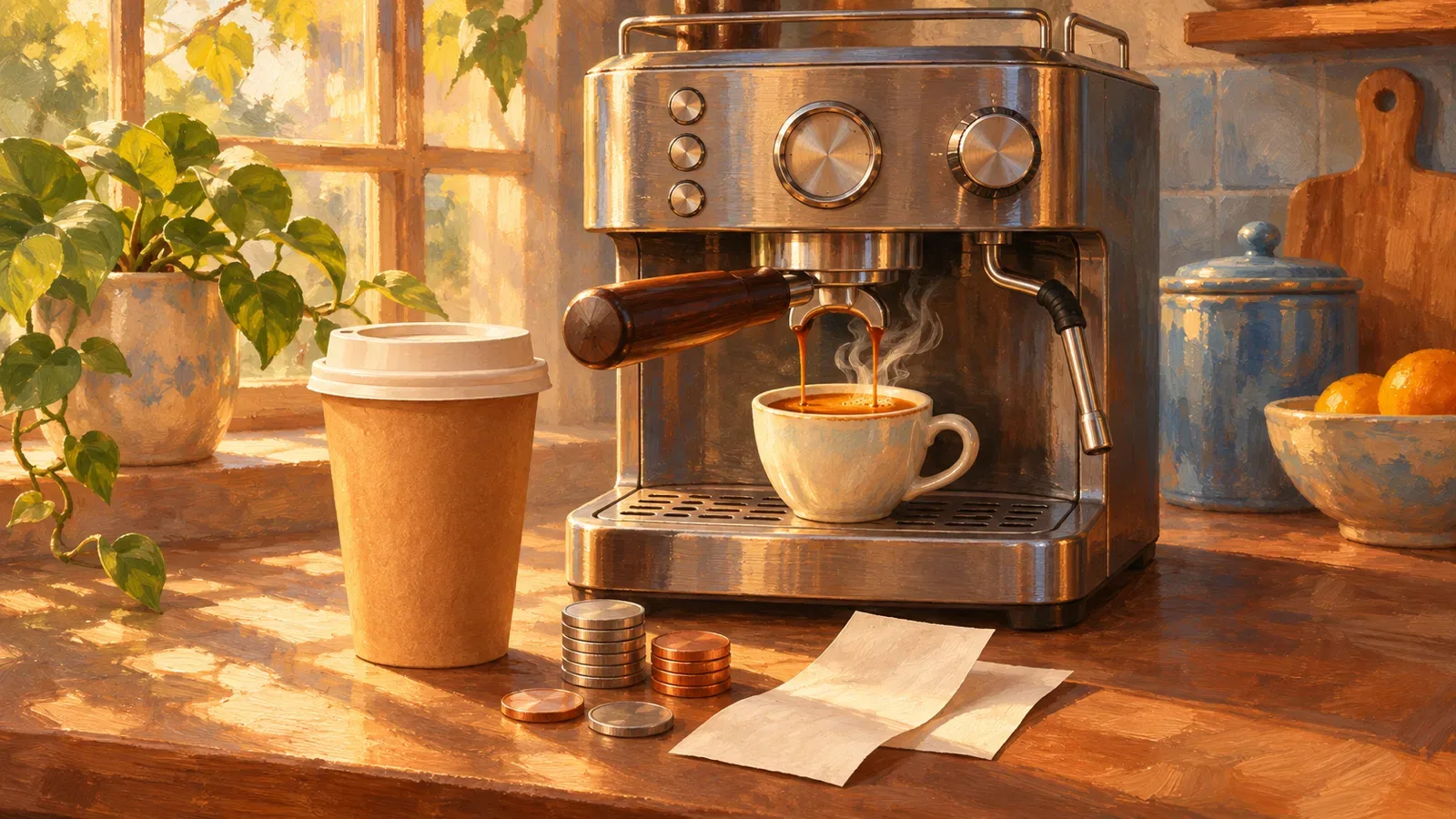
Here is the receipt, at today's prices.
Key takeaways
- At today's $5.45 for a grande latte, two a day is about $3,979 a year. Three a day is about $5,968.
- Over 10 years that is $39,785 to $59,678, before tax and before any price increase.
- A home latte costs about 75 cents in beans and milk, even after coffee prices more than doubled.
- Invest the difference at a 7% real return and two a day becomes about $47,000 in 10 years. Three a day becomes about $71,000.
- Buying for other people multiplies all of it.
- Ten years of the same order, and consistency was the one thing I couldn't buy.
The Receipt
I quit about five years ago, so I'm not using old receipts. This is what the same habit costs at today's prices.
Starbucks publishes no national price list. Your app shows your store's price. So I'm using one real number: $5.45 for a grande Caffè Latte, from a 2025 Starbucks menu board at a licensed café in California. Another licensed board in West Virginia, also from 2025, charges $5.30. Prices vary by store. Airports and hotels charge more.
At $5.45:
| Habit | Drinks a year | Per year | 10 years |
|---|---|---|---|
| 2 a day | 730 | $3,978.50 | $39,785 |
| 3 a day | 1,095 | $5,967.75 | $59,678 |
That assumes no syrup, no extra shot and no price increase for a decade. It is the cheap version.
Now say you make the same drink at home for about 75 cents (the math is below). Two a day costs about $549 a year at home. Three a day costs about $823. The gap is $3,430 or $5,145 a year.
Put that gap in an index fund instead. I'm assuming a 7% return after inflation. That is an illustrative long-run stock-market number, not a forecast, and it ignores taxes and fees. The formula for saving the same amount every year:
FV = C × ((1 + r)^n − 1) / r
C is what you save each year, r is the return, n is the years. At 7% for 10 years, the multiplier is 13.816.
| Habit | Saved per year | 10 years | 20 years | 30 years |
|---|---|---|---|---|
| 2 a day | $3,430 | $47,389 | $140,611 | $323,992 |
| 3 a day | $5,145 | $71,084 | $210,916 | $485,988 |
All in today's dollars. Thirty years of three lattes a day is roughly half a million dollars of retirement.
For context, a survey by Verasight found that only 5% of American adults buy from a coffee shop every day. At two or three drinks a day, my old habit would put me in the top 5% of a group I had no business leading.
In short
Two or three $5.45 lattes a day cost $3,979 to $5,968 a year. Invested at 7% real, the savings are worth $47,389 to $71,084 after 10 years.
Ten Years, Same Order, Constant Battle
I ordered the exact same drink every day for ten years. I wasn't experimenting. I wanted one thing: consistency. That's what the premium price was supposed to buy.
I didn't get it. I wrote my requests on the order. Whether anyone followed them depended on who was working. Some days it was right. Some days the notes might as well not have existed. Every order was a coin flip, and I paid full price for the coin.
There used to be a barista who knew you and how you liked your coffee. Somewhere along the way, a button replaced that barista. The order goes in, and your request is just one more line on it.
I expected the app to have a feedback channel, so they'd know how bad it was getting. There was none. I called the support line to suggest they add one. I was turned away.
They didn't need my advice. Who am I?
Just one of the loyal customers spending thousands of dollars with them.
That float adds up. At the end of fiscal 2025, Starbucks reported $1.75 billion of deferred revenue on its stored value cards and loyalty program: card loads and Stars that customers hadn't spent yet. Balances like my $10 to $50 are what that number is made of.
Here's what bothers me most: this was fixable. Had they asked loyal customers spending thousands whether they were happy, they could have fixed it. Nobody asked. So I stopped paying.
This isn't about the people behind the counter. It's about a company that built a system to take orders and no system to hear whether they came out right.
Warm Sugar With Caffeine
Here's the part loyal customers don't want to hear: most of what I was buying wasn't great coffee. It was warm sugar with caffeine. A sugar rush in a paper cup, and I came back for it two or three times a day.
Don't take my word for it. Look up the sugar in your usual order on Starbucks' own nutrition information. Then ask yourself whether you're buying coffee or dessert.
The Drink Works Against You
It comes filled to the brim with the lid already on. Nobody adds the sugar before filling it. So you pop the lid, pour in the sugar, and burn yourself on a full cup of hot coffee.
Then you need to stir. There's no room. Stir a cup filled to the top and you spill it.
And in the car? You can't do either. You drive off with whatever you were handed.
For five dollars and change, the drink shouldn't be a fight.
The Price Keeps Creeping
The best long price series is the Pumpkin Spice Latte. Money tracked it: a grande cost $3.35 in 2005 and averaged $6.66 across several US cities in 2026. That is up 99%. Overall prices rose 68% in the same stretch.
A plain grande latte went from $3.65 in 2014 to $4.45 in 2024, up 22%, according to data reported by The Takeout.
To be fair, coffee itself got more expensive. Money's same comparison puts roasted coffee up 84% since 2005. And the Bureau of Labor Statistics shows ground coffee at $9.249 a pound in October 2026, up from $4.174 in January 2020. That is +122%, and it hits my kitchen too.
Starbucks' finance chief said in October 2026 that any 2027 pricing "will remain focused and well below" inflation. We'll see. In its fiscal 2026 fourth quarter, Starbucks' average US ticket rose 5.2%, and on the earnings call the finance chief said about half of that came from pricing and delivery.
In short
The PSL nearly doubled since 2005 while overall prices rose 68%. Coffee beans rose too, which is the honest counterpoint.
The Add-Ons Are Where It Gets You
The base price is the bait. Since mid-2025, Starbucks charges $0.80 for any combination of flavored sauces and syrups (classic syrup is free) and $1 for a matcha scoop. The Takeout listed an extra espresso shot at $1.25 and flavored cold foam at $1.25. Licensed stores set their own prices: the West Virginia board charges $1.35 for sweet cream cold foam.
Add one flavored syrup at $0.80 to every drink and three a day costs another $876 a year, or $8,760 over 10 years. Two a day: $584 a year.
Fortune reports the average purchase, with food and add-ons, at about $9. CEO Brian Niccol said it himself: "In some cases, you know, a $9 experience does feel like you're splurging."
One fair point: Starbucks dropped the non-dairy milk charge at US and Canadian company stores on November 7, 2024, and said almost half of customers who paid to customize their drinks would see prices fall by more than 10%. Credit where due. Licensed stores may still charge for it.
Rewards Got Worse, Twice
If you think the app makes it a deal, check the dates. Both of these came after I left. This is what the loyal customers who stayed got.
February 13, 2023: a brewed coffee, bakery item or hot tea went from 50 to 100 Stars. Double. Handcrafted drinks went from 150 to 200 Stars. Lunch went from 200 to 300. (Iced coffee did drop from 150 to 100.)
March 10, 2026: the program went to tiers. According to One Mile at a Time, the maximum earn rate fell from 2 Stars per dollar to 1.5 for base members, a 25% cut, and to 1.7 for Gold, a 15% cut. A new 60-Star reward takes $2 off, or 30 Stars per dollar. The 200-Star reward works out to 20 Stars per dollar only on a $10 drink; on a $5.45 latte it's about 37.
In short
Rewards redemptions got pricier in 2023, and the 2026 tiers cut the top earn rate for Green and Gold members by 15 to 25%.
The Home Version
I make my coffee at home now, on coffee machines in my own kitchen. I get exactly what I want, every time. No notes, no coin flip. And I've come to enjoy learning what actually goes into my coffee.
One warning from experience. I tried pod machines as a shortcut. I went through six of them. They were flaky and kept breaking. That's my experience, not a study. The setups below skip pods.
The math. These are my assumptions, not facts: a double shot uses 18 grams of beans, a 16-ounce latte uses about 12 ounces of milk, and drip uses 2 tablespoons of grounds (about 5 grams each) per 6 ounces of water. Prices are BLS city averages from October 2026: $9.249 a pound for ground coffee, $4.101 a gallon for whole milk.
- Latte: 37 cents of coffee plus 38 cents of milk = about $0.75. Buy specialty beans at double the price and it's about $1.12.
- 16-ounce drip: about 27 grams of coffee = about $0.54, against $2.95 to $3.95 for a grande brewed coffee on those two menu boards.
The machine, grinder, filters, power and your time aren't included. Divide whatever you pay for equipment by the cups you make. At two a day, that's 730 cups a year.
A no-nonsense drip setup: a basic automatic drip machine or a pour-over cone, paper filters, a kitchen scale, and a burr grinder if you buy whole beans. That's it.
A no-nonsense latte setup: an entry-level espresso machine with a steam wand, or a stovetop moka pot plus a handheld milk frother. Add a burr grinder. The moka route isn't true espresso, but it makes a strong base for a milk drink.
No brands, no links.
I Bought for Other People Too
Buy one round of four grande lattes and that's $21.80 in a single stop. Do that once a week and it's over $1,100 a year, on top of your own habit. It feels generous. It's also the fastest way to turn a $5 habit into a $20 one.
You can still treat people. Just do it cheaper:
- Bring a carafe. Eight 16-ounce cups of home drip cost about $4.35 in coffee.
- Host the coffee. A home latte for a friend costs about 75 cents.
- Make it rare. A round once a month means more than one every Friday, and costs less than a quarter as much.
- Pick a cheaper drink. A grande brewed coffee is $3.95 on the California board, $1.50 less than the latte.
Same math, different trap: why I never buy the extended warranty, and what the federal budget looks like as a household budget.
The 30-Day Challenge
One rule: every time you would have bought a drink, move $5.45 into savings. Not later. Right then, from your phone.
At two a day for 30 days, that's $327. At three a day, $490.50. Making the same lattes at home costs about $45 or $68 for the month. Look at the savings balance on day 30 and decide if you want to go back.
FAQ
Hasn't coffee gotten so expensive that home brewing doesn't save much?
No. Ground coffee more than doubled since 2020, and a home latte still costs about 75 cents against $5.45.
Doesn't Starbucks Rewards make up the difference?
No. Redemptions doubled for brewed coffee in 2023, and the 2026 tiers cut the top earn rate for base members by 25%.
Is a 7% return realistic?
It's an illustrative long-run, after-inflation stock-market assumption, not a promise. Even with zero return, two a day saves $34,299 over 10 years and three a day saves $51,449.
What about the machine?
It isn't in the 75 cents. Divide its price by the 730 to 1,095 cups a year you'd make.
Sources
- Palomar College Food Services, Starbucks menu boards (board dated January 2025, posted October 2025): https://www.palomar.edu/foodservices/wp-content/uploads/sites/292/2025/10/Starbucks-Menu-Boards.pdf
- WVU Tech Dining, Starbucks Keyser menu board (August 14, 2025): https://dining.wvutech.edu/wp-content/uploads/menus/Menu_Board_1920x1080-Starbucks-Keyser_8.14.25.pdf
- The Takeout, Starbucks drink and add-on prices, 2014 to 2024 (May 12, 2025): https://www.thetakeout.com/1853224/most-expensive-starbucks-drink-app/
- Money, Adam Hardy, Pumpkin Spice Latte cost increase (August 25, 2026): https://money.com/pumpkin-spice-latte-cost-increase/
- Restaurant Dive, Starbucks FY26 Q4 results and pricing outlook (October 30, 2026): https://www.restaurantdive.com/news/starbucks-ticket-traffic-merch-turnaround-becomes-growth/873299/
- Starbucks, Q4 FY26 earnings call transcript (October 29, 2026): https://s203.q4cdn.com/326826266/files/content_files/Q4-FY26-SBUX-Transcript.pdf
- Restaurant Dive, Starbucks drink modifier pricing changes (June 26, 2025): https://www.restaurantdive.com/news/starbucks-pricing-changes-drink-modifiers/751644/
- Starbucks, FY26 Q4 earnings release, SEC Form 8-K (October 29, 2026): https://www.sec.gov/Archives/edgar/data/0000829224/000082922426000154/sbux-09272026xearningsrele.htm
- Starbucks, removal of the extra charge for non-dairy milk (October 30, 2024): https://about.starbucks.com/press/2024/starbucks-announces-removal-of-extra-charge-for-non-dairy-milk-starting-nov-7/
- Starbucks, Fiscal 2025 Annual Report (Form 10-K), Note 11: Deferred Revenue, stored value cards and loyalty program at September 28, 2025: https://s203.q4cdn.com/326826266/files/doc_financials/2025/ar/Starbucks-Corporation_2025-Annual-Report-Web-Ready.pdf
- Fortune, Starbucks CEO on the $9 coffee (May 4, 2026): https://fortune.com/2026/05/04/starbucks-ceo-roasted-9dollar-coffee-premium-wall-street-earnings/
- AwardWallet, Starbucks Rewards changes for February 2023 (December 31, 2022): https://awardwallet.com/news/starbucks-rewards-changes-february-2023/
- One Mile at a Time, Starbucks Rewards 2026 tiers (March 10, 2026): https://onemileatatime.com/news/starbucks-rewards-changes-devaluation-elite-status/
- Bureau of Labor Statistics, average price of ground roast coffee, series APU0000717311 (retrieved November 15, 2026): https://data.bls.gov/timeseries/APU0000717311
- Bureau of Labor Statistics, average price of whole milk, series APU0000709112 (retrieved November 15, 2026): https://data.bls.gov/timeseries/APU0000709112
- Verasight, how adults think about coffee brands and habits (published May 11, 2026): https://data.verasight.io/culture/how-adults-think-about-coffee-brands-and-habits