
"We've been trying to reach you concerning your car's extended warranty." You know the voicemail. In the first three months of 2021, one operation placed 5,187,677,000 of those calls to 550,138,650 phones. The FCC fined it $299,997,000, the largest robocall fine in its history.
That is the crude version of the pitch. The polished version happens at every checkout counter in America: "Do you want to protect that for $90?"
Here is the short answer, from the companies' own books: no. The extended warranty is one of the most profitable products a store sells, and it is profitable because you lose.
I used to sell these. Years ago I worked the floor at Future Shop, the Canadian electronics chain Best Buy bought in 2001 and shut down in 2015. We were paid on commission, and most of mine came from protection plans, not from the TVs and laptops they were attached to. Some days it felt like my real job was selling warranties, and the technology was just the reason the customer walked in. That is not a knock on the people doing it. It is how the economics work, and the stores' own numbers show why.
The Stores' Own Numbers
You don't need to trust a consumer blog for this. The companies that sell protection plans have to report the numbers to the SEC.
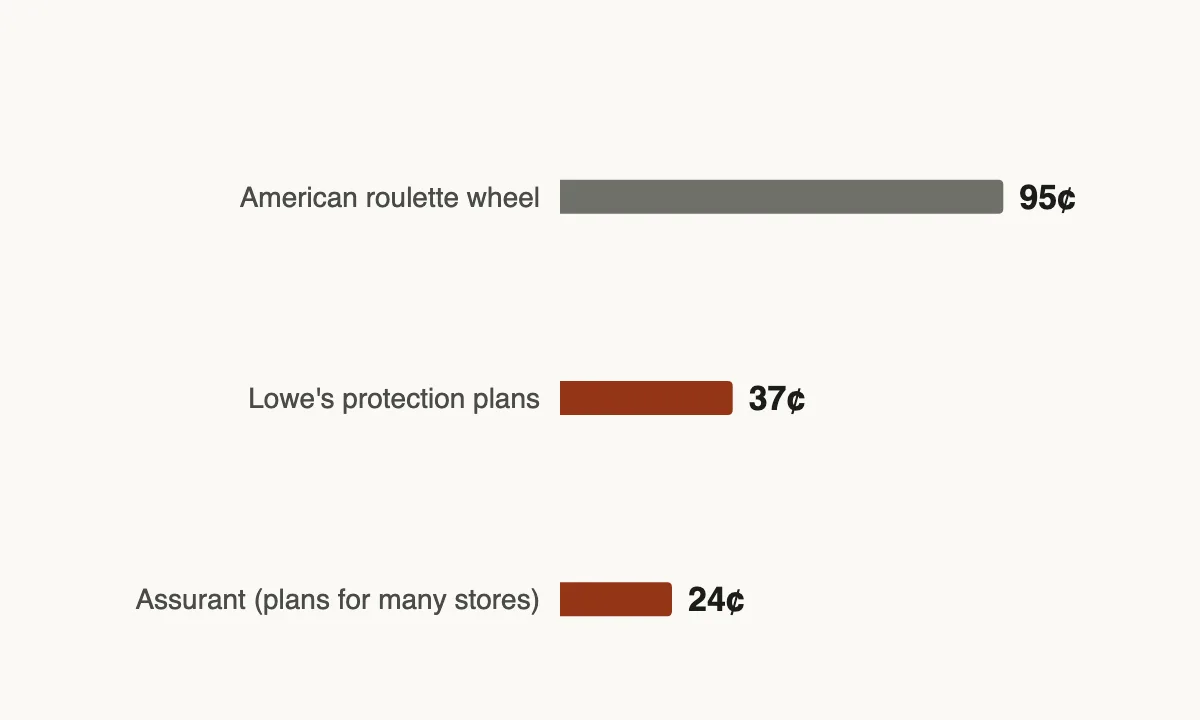
Lowe's runs its own plans. In fiscal 2024 it recognized $561 million of protection-plan revenue and paid $210 million in claims. That is 37 cents back for every dollar customers paid. The three-year average is the same: 37.5%.
Assurant is the giant that underwrites plans for many big retailers. In 2025 its lifestyle division took in $7.89 billion in premiums and paid $1.90 billion in claims: 24 cents on the dollar. It spent $4.99 billion on selling and underwriting, mostly commissions. That is more than two and a half times what it paid to fix anything.
Best Buy doesn't even carry the risk. It sells the plans as an agent and keeps a commission. Those commissions were 0.9% of revenue last fiscal year, about $375 million, roughly a quarter of the company's operating income. Its annual report says it plainly: "We do not share in any losses."
For comparison, an American roulette wheel keeps about 5 cents of every dollar bet, because 2 of its 38 slots belong to the house. A protection plan keeps 63 to 76 cents.
In short
Per their own SEC filings, Lowe's pays back about 37 cents of every protection-plan dollar and Assurant about 24. Roulette returns 95.
Why the Math Never Works
Three things are stacked against you before you even sign.
The price. Plans cost about 15% of a TV, 22% of a laptop and 11 to 19% of a major appliance, according to Warranty Week's surveys of online retailers. The worst one it found cost 410% of the product it covered.
The odds. Researchers at Kellogg found that shoppers behave as if a product fails 13% of the time. The real rate was about 5%. The plan is priced for the failure you imagine, not the one that happens.
The overlap. Your new product already has a manufacturer's warranty, usually for the first year. You are paying for coverage you already have, then for a few more years in which most products keep working.
And when something does break, the repair often costs about what the plan did. Consumer Reports found the median out-of-pocket laptop repair was $118, about $3 more than the median plan.
In short
Plans are priced for a 13% failure rate when the real one is closer to 5%, and the typical repair costs about as much as the plan.
Most People Never Use It
Consumer Reports found that two-thirds of in-store electronics shoppers and nearly three-quarters of appliance buyers get the pitch. Nearly a third of consumers have bought a plan.
Then they forget about it. Among laptop owners with extended coverage, only 15% of PC owners and 7% of Apple owners ever used it to pay for a repair.
The pitch works because it arrives at the exact moment you have spent $900 and feel nervous about it. That nervousness is the product.
In short
Most buyers are pitched a plan, a third buy one, and for laptops only 7 to 15% of plan holders ever use it.
What "Yes" Costs You Over a Lifetime
Here is a deliberately conservative example. One household buys the usual things over 30 years and says yes to the plan every time. The plan percentages are Warranty Week's averages. The prices and how often things get replaced are round assumptions you can swap for your own.
| Item | Price | Bought in 30 years | Plan cost | 30-year plan spend |
|---|---|---|---|---|
| TV | $600 | 4 | $90.00 (15%) | $360.00 |
| Laptop | $900 | 6 | $198.00 (22%) | $1,188.00 |
| Refrigerator | $1,800 | 2 | $203.40 (11.3%) | $406.80 |
| Washer | $800 | 2 | $112.00 (14%) | $224.00 |
| Dryer | $800 | 2 | $112.00 (14%) | $224.00 |
| Dishwasher | $700 | 3 | $110.60 (15.8%) | $331.80 |
| Microwave | $200 | 3 | $38.20 (19.1%) | $114.60 |
| Total | 22 plans | $2,849.20 |
Now apply what the industry pays back:
- At Lowe's 37.5%, about $1,780 is gone.
- At Assurant's 24%, about $2,160 is gone.
- Even if you round the payback up to a generous 40%, you still lose $1,710.
That is before phones, game consoles, headphones, printers and every other "protect it for $14.99?" add-on, so treat it as a floor.
One honest caveat: laptops are the closest call. They break more often than TVs, and repairs cost about the same as the plan. Take laptops out completely and the rest of the plans still lose you about $1,000 to $1,260.
In short
A household that says yes every time pays about $2,850 for 22 plans over 30 years and loses roughly $1,700 to $2,200 of it.
What You Already Have for Free
You are not unprotected without the plan. You probably already have most of what it sells.
- Implied warranties. The FTC says laws in every state create "unspoken promises" that a product will do what it is supposed to. In some states they last up to four years.
- A federal backstop. Under the Magnuson-Moss Warranty Act, a seller that gives a written warranty, or sells you a service contract within 90 days, cannot take away those implied warranties.
- Your credit card. Chase Sapphire Preferred adds a year to manufacturer warranties of three years or less. American Express Gold and Platinum add up to a year to warranties of five years or less, up to $10,000 per item. Citi Strata Premier lists an extended warranty benefit too. Check your own card's terms; not every card has it.
- The return window. Buy from a store with a generous return policy, and the first weeks are covered by the store itself.
- Time to think. Many retailers let you add a plan for weeks after purchase, so there is no reason to decide at the register.
In short
Implied warranties, federal law, your credit card and the store's return policy already cover much of what the plan sells.
The Car Exception, With the Fine Print
Here is where I break my own rule. A car is the one purchase where I would consider an extended warranty. Not because the plan is a good bet, but because a single failure can cost a month's pay or more.
- A transmission replacement costs $6,238 to $6,764, according to RepairPal.
- Car repair prices rose 5.6% in a year when overall prices rose 2.4%, according to the Bureau of Labor Statistics.
- The average car on American roads is now 12.8 years old, a record, according to S&P Global Mobility. People keep cars long past the factory warranty.
- Consumer Reports found new EVs and plug-in hybrids had about 80% more problems than gas-only cars.
But say the quiet part too. Consumer Reports surveyed more than 12,000 owners: 55% never used their car plan. The average plan cost $1,214, and the people who used theirs saved a median $837. Car plans lose money on average too. Dealers also mark them up heavily: a National Consumer Law Center study found an average markup of 83%, or $859 on top of a $1,032 cost.
So the car plan is insurance against a disaster, not a way to win. It makes sense only when all of these are true:
- You will keep the car well past the factory warranty.
- The car is complex, luxury or less reliable, or a new EV or plug-in hybrid. BMW owners used their plans 71% of the time; Toyota and Honda owners, 39%.
- The plan is backed by the manufacturer, so any dealer of that brand honors it. Consumer Reports found buyers of factory-backed plans happier, for a price gap of only about $100.
- You negotiate. Only a third of buyers bargained, and most who did saved about $325. Get quotes from other dealers of the same brand, and pay cash instead of rolling the plan into your loan.
- A $6,000 repair would wreck your budget. If it wouldn't, put the $1,200 in savings and be your own insurer.
And never, ever buy one from a phone call or a TV ad. The FTC made CarShield pay $10 million and found that its celebrity endorsers, Ice-T and Chris Berman, "were not 'real' customers." It has since mailed refund checks to 168,179 people. Another seller, American Vehicle Protection, was banned from the industry for life.
In short
Car plans lose money on average too, but a factory-backed, negotiated plan can be reasonable insurance if you keep the car a long time and a $6,000 repair would sink you.
What to Do Instead
- Say no at the register. You can usually add a plan later if you change your mind.
- Pay with a card that extends the warranty, and keep the receipt.
- Open a repair fund. Put the plan price into savings every time you say no. Now you are the insurer, and you keep the margin. (More money basics in 8 basic life skills people lack.)
- Check reliability ratings before you buy. Picking a reliable model does more than any plan.
- Buy where the return policy is generous.
- If something breaks soon after the warranty ends, ask the manufacturer. Some fix things as a courtesy, and your state's implied warranty may still apply.
- Phones are the one gadget to think about. Accidental damage, not failure, is the real risk. Consumer Reports calls smartphones the "rare case" where a plan may be worth it.
- For cars: factory-backed only, negotiated price only, long ownership only. Hang up on every "your warranty is expiring" call.
Back in 2008, Consumer Reports' Rik Paul put it in one sentence: "Sellers know what tends to break, and in most cases consumers are betting against the house." The fix is simple. Stop betting. Be the house.
If you like this kind of math, here is what the federal budget looks like as a household budget, what it really costs to keep astronauts alive in space, and why a trade can be a safer bet than a coding degree.
Sources
- FCC, Forfeiture Order FCC 23-64 (August 2023), robocall figures and script: https://docs.fcc.gov/public/attachments/FCC-23-64A1.pdf
- Lowe's 10-K for fiscal 2024, protection plan revenue and claims: https://www.sec.gov/Archives/edgar/data/60667/000006066725000049/low-20250131.htm
- Assurant 10-K for 2025, Global Lifestyle premiums, benefits and expenses: https://www.sec.gov/Archives/edgar/data/1267238/000126723826000010/aiz-20251231.htm
- Best Buy 10-K for fiscal 2026, extended warranty commissions: https://www.sec.gov/Archives/edgar/data/764478/000076447826000009/bby-20260131.htm
- Warranty Week, electronics plan pricing (Feb 2025): https://www.warrantyweek.com/archive/ww20250220.html and appliance plan pricing (Mar 2026): https://www.warrantyweek.com/archive/ww20260305.html
- Kellogg Insight, "No, Extended Warranties Are Usually Not Worth It" (2019), on Abito and Salant: https://insight.kellogg.northwestern.edu/article/extended-warranty-worth-it
- Consumer Reports, "Don't Buy Extended Warranties" (2018): https://www.consumerreports.org/shopping/dont-buy-extended-warranties/
- Consumer Reports, laptop extended warranties (2019): https://www.consumerreports.org/extended-warranties/extended-warranty-for-laptop-should-you-buy
- FTC, "Warranties" (2023): https://consumer.ftc.gov/articles/warranties
- Magnuson-Moss Warranty Act, 15 U.S.C. § 2308: https://www.law.cornell.edu/uscode/text/15/2308
- Chase Sapphire Preferred benefits: https://creditcards.chase.com/rewards-credit-cards/sapphire/preferred
- American Express extended warranty benefit guide: https://www.americanexpress.com/content/dam/amex/us/credit-cards/features-benefits/EW-Benefit-Guide_314-400_EDT_10.21_REV_4.24_a11y.pdf
- Citi Strata Premier benefits: https://www.citi.com/credit-cards/citi-strata-premier-credit-card
- RepairPal, transmission replacement cost: https://repairpal.com/estimator/transmission-replacement-cost
- BLS, consumer prices through February 2026: https://www.bls.gov/opub/ted/2026/consumer-prices-up-2-4-percent-over-year-ended-february-2026.htm
- S&P Global Mobility, average vehicle age 2025: https://press.spglobal.com/2025-05-21-U-S-Vehicle-Age-Rises-Again-to-12-8-Years-in-2025,-According-to-S-P-Global-Mobility
- Consumer Reports, EV and PHEV reliability (Dec 2025): https://www.consumerreports.org/cars/car-reliability-owner-satisfaction/new-evs-have-more-problems-than-gas-powered-cars-a1047214174/
- Consumer Reports, "Extended Car Warranties: An Expensive Gamble" (2014, survey data from late 2013): https://www.consumerreports.org/extended-warranties/extended-car-warranties-an-expensive-gamble
- Consumer Reports press release (2008), Rik Paul quote: https://www.consumerreports.org/media-room/press-releases/2008/02/new-consumer-reports-survey-confirms-extended-auto-warranties-a-high-priced-gamble/
- National Consumer Law Center, "Auto Add-Ons Add Up" (2017): https://filearchive.nclc.org/car_sales/report-auto-add-on.pdf
- FTC, CarShield settlement (July 2024): https://www.ftc.gov/news-events/news/press-releases/2024/07/carshield-nationwide-seller-vehicle-service-contracts-pay-10-million-resolve-federal-trade and refunds (Dec 2025): https://www.ftc.gov/news-events/news/press-releases/2025/12/ftc-sends-more-96-million-consumers-who-bought-deceptively-advertised-vehicle-service-contracts
- FTC, American Vehicle Protection ban (2023): https://www.ftc.gov/node/80729