
If your car calls for regular, premium is a tip. You are leaving it for the oil company.
The word premium makes a higher price sound like responsible maintenance. It isn't. Your engine has a fuel requirement printed in the manual and usually on the fuel door. Read that before you buy the adjective.
Key takeaways
- Premium cost about $1.02 more per gallon in the EIA's week-of-November-9 figures: 25.5% above regular.
- At average light-duty fuel use, that is about $468 extra a year.
- AAA found no meaningful overall fuel-economy benefit from premium in its regular-fuel test cars.
- Premium-required engines need the specified fuel. Premium-recommended engines deserve an honest cost-versus-performance decision.
- Aggressive highway driving can cost the average car $324–$788 a year in extra fuel. Your right foot matters more than the pump button.
The $1.02 Tip
For the week of November 9, 2026, the Energy Information Administration put U.S. average regular gasoline at $3.995 a gallon. Premium was $5.013. The gap was $1.018, or 25.5%.
The Federal Highway Administration's 2024 figures put average annual light-duty consumption at 460 gallons per vehicle. Use that consumption and the cited price gap:
460 gallons × $1.018 extra per gallon ≈ $468 a year.
That is an illustration using a national vehicle average, not a prediction for your commute. A pickup or large SUV using the FHWA long-wheelbase average of 579 gallons would pay about $589 extra.
The surcharge used to be smaller. AAA's 2016 report used a 49.33-cent gap. EIA puts the 2025 annual-average gap at about 93 cents.
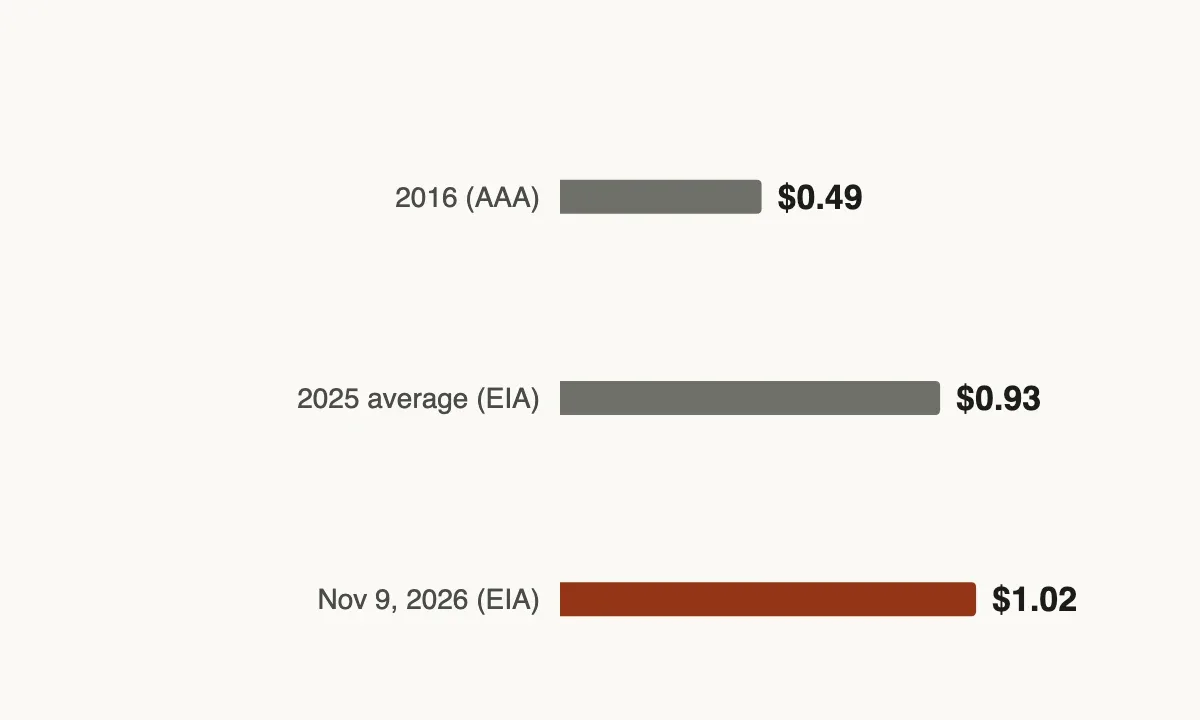
Sources: AAA's price average for the year ending August 26, 2016; EIA's 2025 annual average; EIA's week of November 9, 2026. Separate observations with different windows, not a continuous price series.
Buy What the Manual Calls For
AAA's engineering director described premium as “higher octane, not higher quality.” Its regular-fuel tests found no useful overall payoff for buying the higher number.
The famous waste estimate needs its date attached. AAA estimated Americans unnecessarily spent more than $2.1 billion on premium in regular-fuel cars in 2016. That was a survey-based extrapolation at the old price gap, not a count of everyone's receipts.
Reprice the same assumed fuel volume at the November gap and the estimate becomes roughly $4.4 billion. That is arithmetic using old behavior, not a new AAA finding. It assumes Americans still buy unnecessary premium as they did in that survey.
You do not need a national estimate to check your own purchase. If the manual specifies regular, the extra charge needs a benefit that a premium label cannot supply.
Octane Is Knock Resistance
The federal fuel-rating rule defines the U.S. pump number as the average of research and motor octane ratings: (R + M) / 2. It measures resistance to knock, the unwanted combustion that can damage an engine.
Higher octane helps an engine designed to use that resistance. It can let the engine operate as intended under demanding combustion conditions. The octane number itself makes no promise about detergent content or the horsepower your particular engine will produce.
Putting premium into a regular-fuel car does not make it knock. Using fuel below the octane the engine requires is the dangerous direction.
And compression ratio alone cannot settle the question. Mazda's non-turbo engine in the 2024 CX-5 has a 13.0:1 compression ratio and permits 87 octane. Engine design and calibration matter. Read the manufacturer's fuel instruction.
The Federal Trade Commission challenged the upgrade story long ago. In its 1997 Exxon settlement, the company had to run educational ads saying most cars would operate properly on regular octane. Paying more had already become a consumer-protection issue.
AAA Put It on a Dyno
AAA's 2016 researchers tested regular-fuel versions of a Toyota Tundra, Dodge Charger and Mazda3. They compared 87 with 93 octane on a chassis dynamometer.
Peak horsepower changed by −1.51% in the Tundra, −0.19% in the Charger and +2.36% in the Mazda3. Those results provide no consistent horsepower argument for premium in these regular-fuel vehicles.
The average fuel-economy change was +0.21%. Variation between repeated runs on the same fuel reached 2.28%. The supposed gain was smaller than the test noise. Emissions showed no consistent difference either.
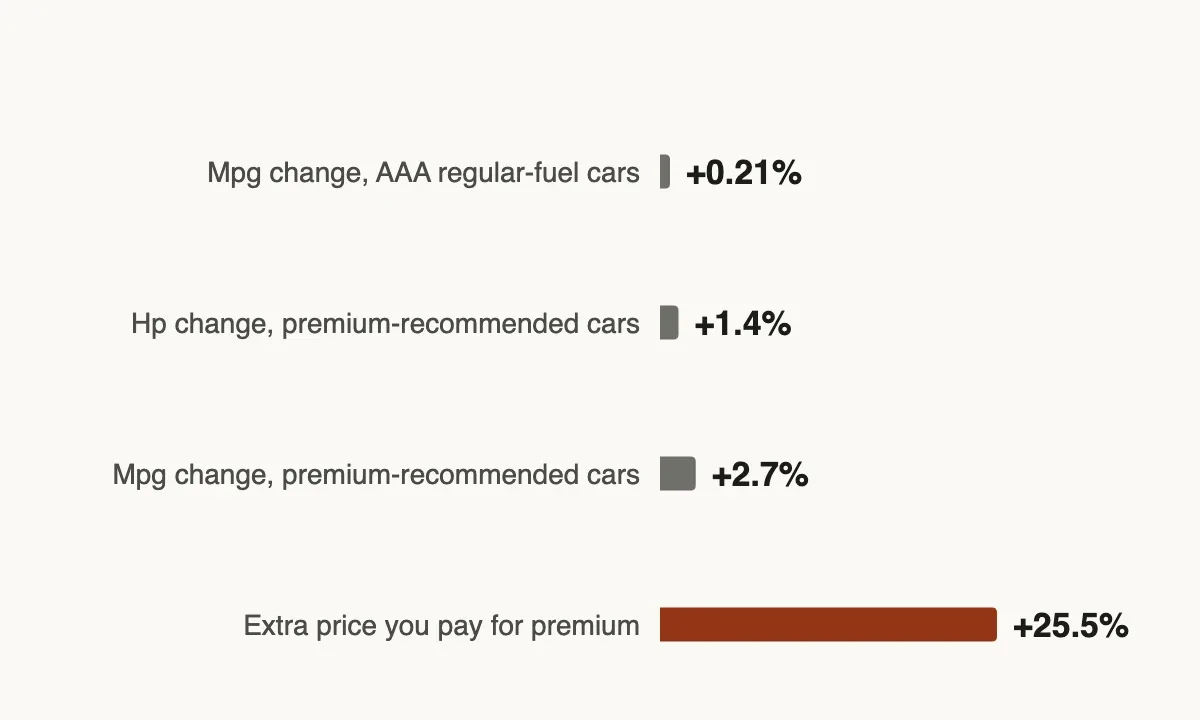
Sources: AAA's 2016 regular-fuel tests and separate 2017 premium-recommended tests; EIA prices for November 9, 2026. Horsepower, mpg and price changes are distinct measures. The price surcharge is 25.5%.
AAA did not test regular in premium-required engines. You cannot use this experiment as permission to ignore a fuel requirement it never examined.
Required Means Required
If the manual requires premium, buy it. The government's fueleconomy.gov guidance says lower-than-required octane can cause poor running and engine damage, and may void the warranty. Saving at the pump can become an expensive repair experiment.
“Recommended” leaves you a choice. Follow the manual's permitted minimum. Modern knock control can adjust ignition timing, but that protection does not guarantee identical power or economy.
AAA tested six premium-recommended vehicles in 2017 under simulated towing, cargo hauling and aggressive acceleration. Premium improved horsepower by 1.4% and fuel economy by 2.7% on average. The biggest economy improvement was 7.1% in the Escalade.
Those gains existed. AAA also said they did not offset the higher fuel price. Even the best economy result was well short of the 25.5% surcharge in the cited current prices.
Mazda supplies a useful warning against promising nobody will notice. Its 2024 CX-5 Turbo is rated at 227 horsepower on 87 octane and 256 on 93. That is about 11% less peak power on regular.
Those are peak ratings, relevant to hard, full-throttle use. They do not mean every journey loses that proportion of performance. They also do not entitle anyone to promise every turbo driver will feel no difference.
Count Configurations Carefully
The Department of Energy says 26.7% of model-year-2023 light-duty configurations required premium. Another 26.3% recommended it without requiring it.
Configurations are not cars sold. An engine-and-trim offering counts in that dataset regardless of how many buyers choose it. These figures cannot tell you that half the cars sold need premium.
AAA's older survey measures something else again. In 2016, 16% of respondents said their vehicles required premium. That answer was self-reported, not checked against their manuals.
Among drivers reporting regular-fuel cars, 11% said they had bought premium at least once in the previous 12 weeks. The survey's recall period was weeks, even though the public annual-waste headline used months.
Treat that as evidence of the habit. Do not turn a short survey answer into a census of today's fleet.
Your Right Foot Has a Bigger Appetite
Think about sipping a soda versus a glass of water. Either glass can disappear slowly or quickly. The faster you go, the more you sip. Paying for a different label does not make a heavy right foot economical.
Fueleconomy.gov says aggressive driving can reduce highway mpg by roughly 15–30%, and stop-and-go mpg by 10–40%. Its speed example treats each additional 5 mph over 50 as roughly another $0.28 per gallon. That dollar example assumes $4 gasoline; the dollar penalty scales with price.
Do the math on the average car. Regular for 460 gallons costs about $1,838 a year. Lose 15% of your mpg and you burn about 18% more fuel: roughly $324 extra. Lose 30% and you burn about 43% more: roughly $788 extra. Your right foot can cost more than the premium habit, and you can fix it for free.
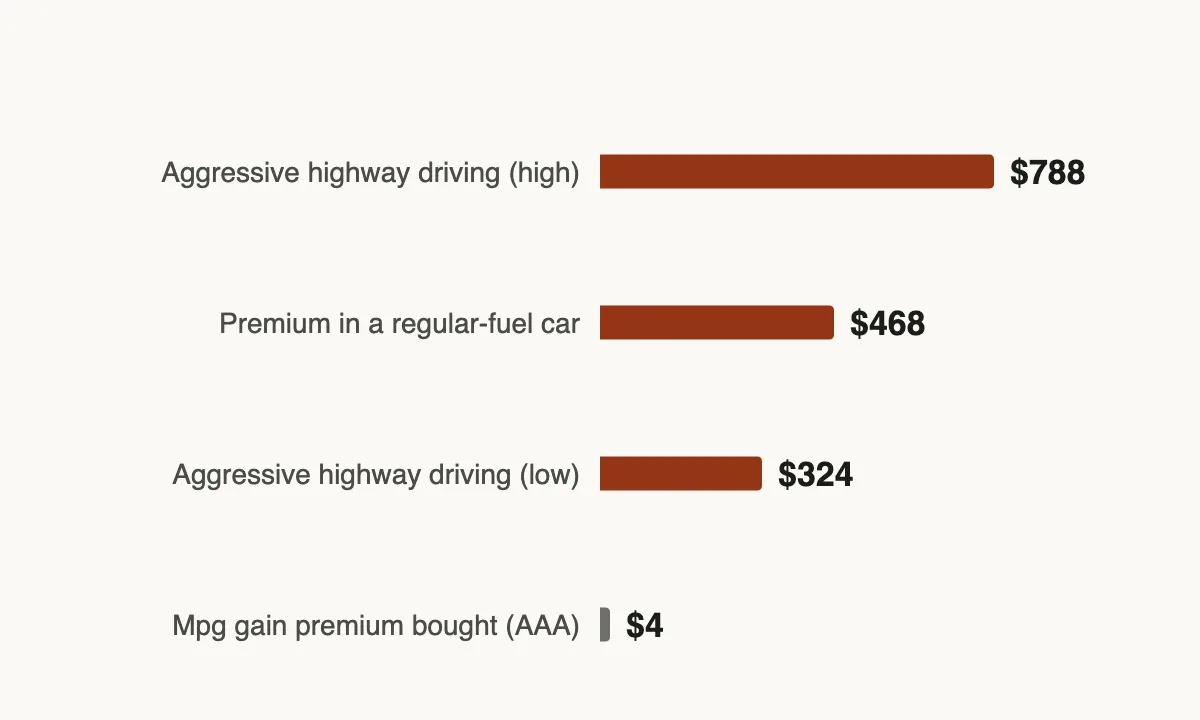
Average vehicle, 460 gallons a year at the November 9, 2026 EIA prices. Premium surcharge: $468. Aggressive highway driving (15–30% lower mpg, fueleconomy.gov): $324–$788 in extra fuel. Premium's measured mpg gain in AAA's regular-fuel cars (0.21%): about $4.
The cabin matters too. Fueleconomy.gov says AC can reduce a conventional vehicle's fuel economy by more than 25% in very hot conditions, especially on short trips. That is a conditional penalty, not an everyday constant.
When the temperature allows it, switch off the AC compressor, use the fans and keep the windows up. Fans move air; they cannot cool it below the outside temperature. Use AC when you need cooling or clear visibility.
Open-window comparisons vary by vehicle and conditions. The government's guidance is windows down at lower speeds and AC at highway speeds. Fans with the windows up avoid making a universal claim about which wins.
Keep AC maintenance in the plan. Mazda's 2016 CX-3 manual says to run it about 10 minutes at least once a month to keep internal parts lubricated. Follow your own manual rather than leaving the system unused indefinitely.
Detergent and Altitude Are Separate Traps
TOP TIER is a detergent standard. Octane is a knock-resistance rating. AAA's advice for treating a regular-fuel car better was to buy TOP TIER at the octane the manual specifies.
In a separate 2016 study, AAA found non-TOP-TIER gasoline produced 19 times as much engine deposit material after 4,000 miles of simulated driving. It reported an average price difference of about 3 cents a gallon. That is evidence about deposits, not a promised mpg increase or a reason to buy higher octane.
Then there is the cheap button at altitude. Some stations sell 85 octane. Fueleconomy.gov says that allowance came from carbureted engines and does not carry over to modern gasoline engines.
If your manual names 87, buy at least 87 even where the station calls 85 regular. “Cheapest the manual allows” is a sound rule. “Cheapest button” can be the wrong fuel.
Read the Fuel Instruction Before Filling
Read the manual or fuel-door label. Required premium gets premium. If regular is permitted, compare any performance benefit with the surcharge instead of buying reassurance by habit. Choose suitable detergent gasoline without confusing its cleaning standard with octane.
Check the manual before your next fill-up. If it permits regular, stop paying for unnecessary premium.
At today's gap and average fuel use, that habit costs about $4,680 over 10 years. That's a used car's down payment, poured into a tank that didn't need it.
Same pattern, different counter: the extended warranty at checkout and the daily coffee habit both charge you for reassurance you never use.
Sources
- EIA, weekly U.S. retail gasoline prices, week of November 9, 2026: https://www.eia.gov/dnav/pet/pet_pri_gnd_dcus_nus_w.htm
- EIA, factors affecting gasoline prices, including 2025 annual grade differences: https://www.eia.gov/energyexplained/gasoline/factors-affecting-gasoline-prices.php
- FHWA, Highway Statistics 2024, Table VM-1: https://www.fhwa.dot.gov/policyinformation/statistics/2024/vm1.cfm
- AAA, 2016 premium-fuel report, including survey appendix: https://newsroom.aaa.com/wp-content/uploads/2016/09/Premium-Fuel-REPORT-FINAL3.pdf
- AAA, 2016 premium-fuel findings and higher-octane/higher-quality distinction: http://newsroom.aaa.com/2016/09/u-s-drivers-waste-2-1-billion-annually-premium-gasoline/
- AAA, 2017 premium-recommended vehicle study: http://newsroom.aaa.com/2017/12/dont-fueled-premium-not-always-worth-price/
- FTC fuel-rating definition, 16 CFR 306.0: https://www.law.cornell.edu/cfr/text/16/306.0
- FTC, 1997 Exxon settlement: https://www.ftc.gov/news-events/news/press-releases/1997/06/exxon-settles-ftc-charges-ground-breaking-educational-ad-campaign-ordered
- Mazda, 2024 CX-5 specifications: https://news.mazdausa.com/download/2024_CX-5+Spec+Deck.pdf
- DOE, model configurations requiring or recommending premium: https://www.energy.gov/node/4843154
- EPA/DOE, selecting the right octane: https://www.fueleconomy.gov/feg/octane.shtml
- EPA/DOE, efficient driving and its price assumptions: https://www.fueleconomy.gov/feg/driveHabits.jsp
- EPA/DOE, hot-weather fuel economy and AC/windows guidance: https://www.fueleconomy.gov/feg/hotweather.shtml
- Mazda, 2016 CX-3 owner's manual, AC lubrication guidance: https://owners-manual.mazda.com/gen/en/2016/cx-3_en/contents/06010100.html
- AAA, 2016 detergent-gasoline study: http://newsroom.aaa.com/2016/07/aaa-not-gasoline-created-equal/